ECG Test Explained: What It Is and Why You May Need It
Author: Vera Ubabuike, MBBS
Medical Writer: Azuka Chinweokwu Ezeike, MBBS, FWACS, FMCOG, MSc (PH)
Highlights
- An ECG is a quick, painless test that records the electrical activity of your heart.
- Your doctor may recommend an ECG if you have symptoms such as chest pain, palpitations, dizziness, fainting, or difficulty breathing.
- An ECG can help identify abnormal heart rhythms, heart block, and changes associated with a heart attack.
- A standard ECG is non-invasive and uses electrodes placed on your chest and limbs to record your heart's electrical activity.
- An abnormal ECG does not always mean that you have heart disease, and a normal ECG does not rule out every heart problem.
- A trained healthcare professional should interpret ECG results alongside your symptoms, medical history, and other tests.
Introduction/What Is an Electrocardiogram (ECG)?
Electrocardiography is a very important investigation used to manage several heart conditions. An electrocardiography is the process of getting a recording of the electrical activity of your heart.
An electrocardiogram (ECG) is a recording of the electrical activity of the heart. It provides information about your heart rate and rhythm, and the conduction of electrical signals in the heart. It can be used to investigate certain heart-related symptoms and to monitor certain illnesses. It can also be used to monitor patients taking certain drugs [1].
This article gives information about what an ECG is, when it is needed, what it can detect, and what to do after an abnormal ECG.
Who Needs an ECG Test?
Your doctor may recommend an ECG if you have symptoms of a heart disease, have a confirmed heart condition, or if the function of your heart needs to be assessed. Individuals who need an ECG can be grouped into:
- Those who have symptoms related to the heart
- Those who may have a heart condition and need to be diagnosed
- Those who are being monitored for a known heart condition
- Those being monitored in specific circumstances
- Those undergoing assessment of the function of their heart
Those with symptoms related to the heart
Some of these symptoms include [2]:
- Chest pain
- Palpitations, i.e., a feeling that your heart is racing or pounding
- Fainting
- Dizziness
- Bluish discolouration of the fingertips or lips (cyanosis)
- Difficulty breathing
- Unexplained seizures
Those who may have a heart condition and need to be diagnosed or monitored
An ECG can be used in the diagnosis and management of some heart conditions or may help in the management of some conditions such as [3,4]:
- Heart attack
- Arrhythmias - abnormal heart rhythms
- Heart block
- Heart failure
- Heart enlargement
- Some electrolyte abnormalities such as abnormal potassium or calcium levels
- Some genetic heart diseases
Those who are being monitored in special circumstances
- People who have recently had heart surgery or a procedure
- People with a cardiac pacemaker or other cardiac devices
- People being monitored in the intensive care unit(ICU)
- People receiving certain medications, e.g., anti-arrhythmics
Those undergoing assessment of the function of their heart
- People in some critical occupations such as pilots, commercial drivers, etc.
- Some professional athletes
- People with cardiovascular risk factors such as hypertension and diabetes may need an ECG
- People with a family history of sudden cardiac death [5]
Types Of ECG
There are different procedures by which an ECG can be done. This largely depends on the reason the ECG is performed. There are different types of ECG machines, and each one is used for specific types of ECGs.
Some types of ECGs include:
- Resting ECG: This type measures the heart’s electrical activity for a few minutes while you lie still.
- Exercise (stress) ECG: In this procedure, an ECG is carried out while you are engaged in exercise, usually on a treadmill or a stationary bicycle.
- Ambulatory ECG: This type uses specialised devices like the Holter monitor to carry out continuous monitoring of ECG over long periods, usually for 24-48 hours or longer.
How to Prepare for an ECG
There are a few steps to take when preparing for an ECG. Some of them include:
- Wear comfortable clothes, e.g., a shirt that can easily be taken off and shoes that can easily be removed if needed
- Wear minimal jewellery, as this will need to be taken off to avoid interference with the ECG machine
- Avoid applying excess body lotion, oils, creams or talcum powder to the chest/skin before the test because this can interfere with electrode adhesion
- Tell the healthcare professional about medications you take
- You may also receive specific instructions regarding food, caffeine, exercise and medications, depending on the type of ECG that is done
How Is an ECG Performed?
- An ECG is usually performed in a private room with the operator and a chaperone, if needed
- You will be asked to take off your shirt. You may also need to take off your shoes
- You will also be required to take off any jewellery or metallic items on you, as they may interfere with the machine
- You will be asked to lie on a couch, facing upward
- Skin preparation involving cleaning, drying, and sometimes shaving the chest is done to enable adherence of the electrodes
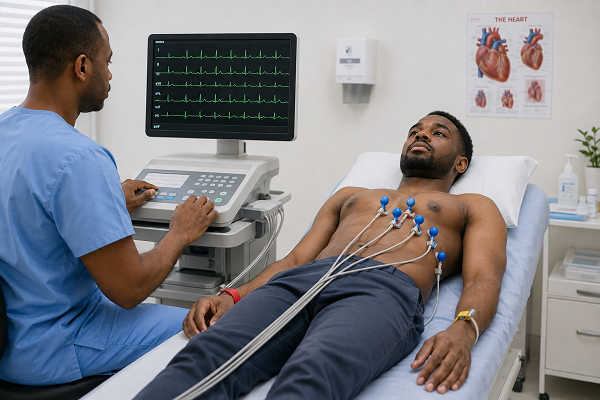
- A standard 12-lead ECG uses 10 electrodes placed on the chest and limbs. These electrodes are small sensors attached to the skin, and they have wires connecting them to the ECG machine.
- Six electrodes will be placed across your chest wall and one electrode each on your right wrist, left wrist, right ankle, and left ankle
- You will be instructed to remain still while the recording is done by the machine
- When the recording is done, the electrodes will be taken off
- You will be asked to dress up, and your ECG recording will be prepared
- The ECG recording will be handed to the assigned healthcare professional for interpretation [1]
Most ECG machines are digital and automated, and they have software that enables them to provide an immediate interpretation of the recording as it is printed out.
What Can an ECG Detect?
An ECG can be used to detect or support the diagnosis of several heart conditions such as [3]:
- Arrhythmias
- Heart block
- Heart enlargement
- Electrolyte abnormality affecting the electrical activity of the heart, e.g., high or low potassium
- Heart attack
- Pericardial effusion
An ECG can also be used to support the diagnosis of some other cardiac conditions like cardiomyopathies, and to monitor the effects of some drugs like digoxin.
What Happens After an Abnormal ECG?
An abnormal ECG may not necessarily mean that you have a serious heart condition. Some abnormalities may be minor and occur in healthy people, while some may require further investigation.
If you get an abnormal ECG, the next steps depend on the reason for which it was done.
- If the ECG was done to detect an illness, an immediate response may be required in certain situations such as a heart attack. This response may involve a repeat ECG, blood tests, imaging, review by specialists, or medication adjustment [6].
- Your healthcare provider will take a detailed history of your signs and symptoms, if that wasn’t done before the ECG. You may also have further investigations done. These will help determine the cause of your illness and its extent [7]. Some of the investigations which may be done include:
- Chest X-ray
- Echocardiography
- Blood tests such as cardiac enzymes
- Electrolytes
- Cardiac imaging
- If the ECG was done to monitor an illness you are currently being treated for, an abnormal ECG may warrant a review of your medication regimen. You should avoid changing the dose of your medication unless instructed to by your healthcare provider.
- If an ECG is done to monitor the effect of a medication, getting an abnormal result may mean that the dose of the medication should be changed or that it should be discontinued completely.
When Should You Seek Medical Attention?
You should see your healthcare provider if you have any symptoms that suggest heart disease, particularly warning signs such as [2]:
- Severe chest pain
- Severe difficulty breathing
- Fainting
- Severe palpitations
You should also seek medical attention if your ECG result has any abnormal findings. An ECG report can be quite complex to understand; therefore, it needs to be interpreted by a healthcare professional who is trained to interpret ECGs.
Conclusion
An ECG is a quick and non-invasive investigation done to assess the function of your heart. It gives information on your heart rate, rhythm, and electrical activity. It can help in the management of several heart conditions and can also be used to monitor the effect of an illness or medication. Warning symptoms of heart disease should prompt you to seek immediate medical attention, and knowledge about the basics of an ECG will help you understand why it is recommended by your doctor.
Frequently Asked Questions (FAQs)
Are there any risks associated with undergoing an ECG?
The standard resting ECG is a very safe procedure. Rarely, individuals may have skin irritation or discomfort due to the application of the electrodes.
Does an ECG hurt?
No, an ECG does not cause pain. It is usually a quick, painless, and non-invasive procedure.
How long does an ECG take?
A standard resting ECG takes only a few minutes to record. Some more time may be spent setting up the machine, performing skin preparation for the procedure, and placing the electrodes at the right location.
Does an abnormal ECG mean that I have heart disease?
Not necessarily. There are many causes of an abnormal ECG. You must consult your doctor for an appropriate interpretation of your ECG.
References
- Kligfield P, Gettes LS, Bailey JJ, et al. Recommendations for the standardization and interpretation of the electrocardiogram. Journal of the American College of Cardiology. 2007;49(10):1109-1127. doi:10.1016/j.jacc.2007.01.024. Accessible at: https://www.jacc.org/doi/10.1016/j.jacc.2007.01.024
- Vidt DG, Prisant LM. Hypertensive heart disease. J of Clinical Hypertension. 2005;7(4):231-238. doi:10.1111/j.1524-6175.2005.04119.x Accessible at: https://onlinelibrary.wiley.com/doi/full/10.1111/j.1524-6175.2005.04119.x?sid=nlm%3Apubmed
- Mason JW, Hancock EW, Gettes LS. Recommendations for the standardization and interpretation of the electrocardiogram. Journal of the American College of Cardiology. 2007;49(10):1128-1135. doi:10.1016/j.jacc.2007.01.025. Accessible at: https://www.jacc.org/doi/10.1016/j.jacc.2007.01.025
- Drew BJ, Califf RM, Funk M, et al. Practice standards for electrocardiographic monitoring in hospital settings: an American Heart Association scientific statement from the councils on cardiovascular nursing, clinical cardiology, and cardiovascular disease in the young: endorsed by the international society of computerized electrocardiology and the American Association of critical-care nurses. Circulation. 2004;110(17):2721-2746. doi:10.1161/01.CIR.0000145144.56673.59. Accessible at: https://www.ahajournals.org/doi/10.1161/01.CIR.0000145144.56673.59?url_ver=Z39.88-2003&rfr_id=ori:rid:crossref.org&rfr_dat=cr_pub%20%200pubmed
- Ferrero‐Miliani L, Holst AG, Pehrson S, Morling N, Bundgaard H. Strategy for clinical evaluation and screening of sudden cardiac death relatives. Fundamental Clinical Pharma. 2010;24(5):619-635. doi:10.1111/j.1472-8206.2010.00864. Accessible at: https://onlinelibrary.wiley.com/doi/10.1111/j.1472-8206.2010.00864.x
- Vafaie M. State-of-the-art diagnosis of myocardial infarction. Diagnosis. 2016;3(4):137-142. doi:10.1515/dx-2016-0024. Accessible at: https://www.degruyterbrill.com/document/doi/10.1515/dx-2016-0024/html
- Gulati M, Levy PD, Mukherjee D, et al. 2021 aha/acc/ase/chest/saem/scct/scmr guideline for the evaluation and diagnosis of chest pain. Journal of the American College of Cardiology. 2021;78(22):e187-e285. doi:10.1016/j.jacc.2021.07.053. Accessible at: https://www.jacc.org/doi/10.1016/j.jacc.2021.07.053
Disclaimer:
The information provided on this website is for general educational and informational purposes only. It is not intended to replace professional medical advice, diagnosis, or treatment. Always seek the advice of your physician or other qualified health provider with any questions you may have regarding a medical condition.
Published August 26, 2028