The Link Between Obesity and Cancer
Medical Writer: Oke Ikpekpe, MSc (PH)
Medical Reviewer: Azuka Chinweokwu Ezeike, MBBS, FWACS, FMCOG, MSc (PH)
Highlights
- Obesity is linked to at least 13 types of cancer
- Body fat is active and can influence how cells grow
- Long-term inflammation from excess fat can damage cells over time
- After menopause, fat tissue becomes a key source of oestrogen
- The immune system may not work as effectively with obesity
- Small, everyday changes in how you eat and move can lower your cancer risk over time.
Introduction
Can your body weight affect your risk of cancer?Many of us think about our weight in terms of appearance or how our clothes fit. But it also affects what’s happening inside the body. Beyond things like joint strain or low energy, carrying extra weight can have a real impact on your long-term health.
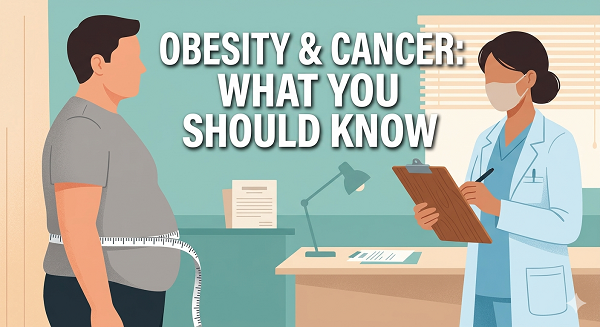
Research shows that being overweight or obese is linked to a higher risk of at least 13 types of cancer [1].
Understanding this connection can help you make small, practical choices that support your health over time.
What is Obesity?
Obesity is a condition where the body has excess body fat in a way that can harm health [2].
The World Health Organisation (WHO) no longer sees obesity as just a matter of discipline. It is now recognised as a chronic condition shaped by genetics, environment, and the way we live today.
One common way to assess this is through Body Mass Index (BMI), a simple calculation that compares your height to your weight to determine if you are in a healthy range [1,2].
- BMI 25–29.9 is considered overweight
- A BMI of 30 or higher is generally considered obesity.
A note on ethnicity: For people of South Asian, Chinese, Middle Eastern, or Black African descent, health risks can start at a lower BMI, often from 23 and above.
BMI is a helpful starting point, but it is an indirect measure of body fat, and it has limitations [2]. It gives a general idea of whether your weight may be affecting your health, but it doesn’t show where fat is stored in the body. For example, fat stored around the middle (visceral fat) is more active and more harmful than fat stored elsewhere.
Because of this, healthcare providers may use additional tools alongside BMI, such as [3]:
- Waist-to-height ratio: Aim to keep your waist size less than half of your height
- Waist circumference: It measures fat stored around your organs.
- Waist-to-hip ratio: May help predict health risks, including cancer, better than BMI alone
How Does Obesity Increase Cancer Risk?
Obesity increases cancer risk because it creates an internal environment where cells are more likely to grow uncontrollably and less likely to be corrected by the body [1].
Extra body fat acts like an active organ. When there is too much of it, fat cells can become stressed and stop working properly [3].
This can lead to long-term, low-level inflammation.
Research has identified several ways this can lead to cancer [3,4]:
- Chronic Inflammation: When there is too much body fat, the body can enter a state of long-term, low-level inflammation.
This means the body is in a constant state of low-level irritation. Over time, this can lead to your cells dividing more than they should, increasing the chance of errors that may develop into cancer. - Hormonal Changes (The Oestrogen Factor): Fat tissue is a major producer of hormones, especially oestrogen. After menopause, when the ovaries stop producing oestrogen, fat tissue becomes the body’s primary source of this hormone.
Higher levels of oestrogen can cause cells in the breast and womb to grow more quickly, which may increase cancer risk in these areas. - Increased Insulin and Growth Signals: People with obesity often have high insulin levels. Insulin helps control blood sugar, but when levels stay high, it can also signal cells to grow and multiply more than they should. Over time, this increases cancer risk.
- Weakened Immune Response: Your immune system helps find and remove abnormal cells before they become cancer. But obesity can slow that system down. It makes it harder for your immune cells, especially the ones called T-cells, to do their job. Some research suggests this may involve changes in genes such as PHD3 [5].
- Belly Fat and Cancer Risk: Fat stored around the abdomen (belly fat) is more active than fat in other parts of the body.
It releases more harmful signals that affect inflammation and how the body uses insulin, making it a stronger risk factor for cancer.
Types of Cancers Linked to Obesity
Being overweight or obese is linked to a higher risk of 13 different types of cancer [1]. Globally, an estimated 4–8% of all cancers are attributed to obesity, ranging from less than 1% in low-income countries to 7–8% in high-income countries [4].
Obesity does not just increase your risk of getting cancer. It also makes cancer more likely to come back by about 13%. And it raises the risk of dying from cancer by about 17% [3].
The 13 cancers most strongly associated with obesity include [1, 3, 4]:
- Breast cancer (after menopause) – influenced by changes in oestrogen levels
- Colorectal (bowel) cancer – affects the large intestine and rectum
- Endometrial (womb) cancer – linked to higher levels of oestrogen
- Oesophageal cancer – affects the food pipe
- Pancreatic cancer – affects the pancreas, which helps control blood sugar
- Kidney cancer – develops in the kidneys, which filter waste from the body
- Liver cancer – affects the liver, an important organ for detoxification
- Upper stomach cancer – occurs in the upper part of the stomach
- Gallbladder cancer – affects the organ that stores bile
- Ovarian cancer – affects the ovaries in women
- Thyroid cancer – affects the thyroid gland in the neck
- Multiple myeloma – a type of blood cancer
- Meningioma – a type of brain tumour
This doesn’t mean someone will definitely develop cancer, but the risk is higher than for someone at a healthy weight.
How to Reduce Your Risk?
You can lower your risk of having cancer by keeping a healthy weight, which can be achieved by [1,2]:
- Follow a Healthy Eating Plan:
Aim to eat a little less than your body uses each day, about 500 to 750 fewer calories. This leads to steady, healthy weight loss. - Get Regular Physical Activity:
Exercise does more than burn calories. It specifically targets belly fat, the dangerous kind around your organs. And when you pair exercise with healthy eating, the benefits multiply. Your insulin levels drop, and inflammation goes down, thereby reducing cancer risk. - Use Behavioural Strategies:
Long-term change is easier with a plan. Try keeping a food and activity log. Set small, realistic goals. Notice what triggers you to overeat and change your environment to avoid those traps. - Talk to Your Doctor:
Your healthcare provider can check your BMI, explain your personal risk, and point you to local programs that work. And if lifestyle changes are not enough, there are other options, medications like semaglutide or liraglutide, and even bariatric surgery for those who need it. Your doctor can help you figure out what is right for you.
Conclusion
Over 1 billion people around the world live with obesity. And yes, modern life, from the food we eat to how little we move, plays a huge role.Your weight is not just about how you look. It affects how your body works and your risk of cancer.By choosing small, consistent changes today, you are taking a stand for your future health and significantly lowering your cancer risk.
Frequently Asked Questions (FAQs)
Do I have to reach a perfect BMI to see benefits?
No! Research shows that even losing 5% to 10% of your body weight can significantly improve your metabolic health and reduce inflammation [6].
Is exercise enough on its own?
While exercise is vital for heart health and reducing inflammation, it works best for weight management when paired with a mindful eating plan.
Which cancers are most strongly linked to obesity?
The most common associations include post-menopausal breast, colorectal, endometrial, kidney, and liver cancers.
Can losing weight help after a cancer diagnosis?
Yes. Studies show that weight loss after a cancer diagnosis can improve survival and reduce the risk of cancer returning
Are there specific foods that increase or decrease cancer risk?
Yes, but focus on your overall eating pattern rather than single foods. Diets rich in vegetables, fruits, whole grains, legumes, lean proteins, and healthy fats are linked to a lower risk. In contrast, ultra-processed foods, sugary drinks, and high intake of red or processed meats may increase risk.
References
- Centers for Disease Control and Prevention. Obesity and cancer [Internet]. Atlanta (GA): CDC; 2025 [cited 2026 Apr 20]. Available from: https://www.cdc.gov/cancer/risk-factors/obesity.html
- World Health Organisation. Obesity and overweight [Internet]. Geneva: WHO; 2025 [cited 2026 Apr 20]. Available from: https://www.who.int/news-room/fact-sheets/detail/obesity-and-overweight
- Nagasri MT, Reddy PS, Pasupuleti A, Akula S. Obesity and lifestyle changes: a global risk factor for cancer. Obes Diabetes Res. 2023;4(1):123. Available from: https://www.scholarsliterature.com/article_pdf/11/scientific_11_782_18102023121604.pdf. doi:10.47275/2692-0964-123
- Pati S, Irfan W, Jameel A, Ahmed S, Shahid RK. Obesity and cancer: a current overview of epidemiology, pathogenesis, outcomes, and management. Cancers (Basel). 2023 Jan 12;15(2):485. Available from: https://pmc.ncbi.nlm.nih.gov/articles/PMC9857053/. doi:10.3390/cancers15020485
- Rathmell JC. Obesity, immunity, and cancer. N Engl J Med. 2021 Mar 25;384(12):1160–1162. Available from: https://pmc.ncbi.nlm.nih.gov/articles/PMC8053443/. doi:10.1056/NEJMcibr2035081
- Ryan DH, Yockey SR. Weight loss and improvement in comorbidity: differences at 5%, 10%, 15%, and over. Curr Obes Rep. 2017 Jun;6(2):187–194. doi:10.1007/s13679-017-0262-y. PMID: 28455679; PMCID: PMC5497590. Available from: https://pmc.ncbi.nlm.nih.gov/articles/PMC5497590/
Disclaimer:
The information provided on this website is for general educational and informational purposes only. It is not intended to replace professional medical advice, diagnosis, or treatment. Always seek the advice of your physician or other qualified health provider with any questions you may have regarding a medical condition.
Published April 22, 2026