Breast Cancer: Why Early Detection is Important
Author: Agu Chiamaka Sarah, MBBS
Medical Reviewer: Azuka Chinweokwu Ezeike, MBBS, FWACS, FMCOG, MSc (PH)
Highlights:
- Breast cancer is the most common cancer in women globally.
- It is caused by abnormal breast cells growing uncontrollably.
- The risk of breast cancer increases with age.
- Early detection involves two strategies: Screening and Early diagnosis.
- Early detection increases the survival rate, ensures better treatment outcomes and ensures an improved quality of life.
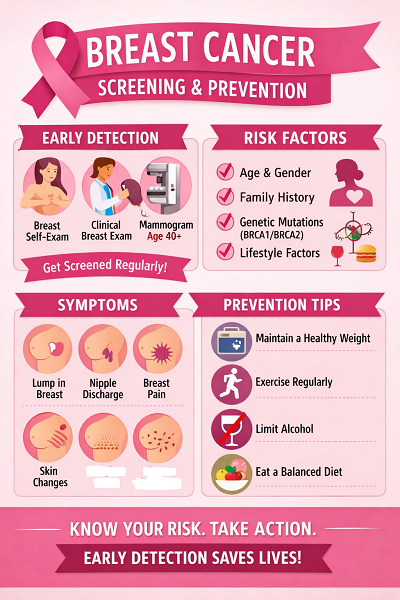
- Breast Self-exam, Clinical Breast Exam and Mammograms are ways to detect breast cancer early.
Introduction
Can you imagine the pain of losing someone you love to a disease that could have been treated successfully if only it had been detected early?
Breast cancer ranks second globally in terms of cancer-related deaths among women and is the most common cancer diagnosed in women.
Screening programs in western nations have been successful in identifying the majority of breast cancers early on, frequently before they spread. Unfortunately, breast cancer is often discovered in advanced stages in most parts of the developing world because of late diagnosis.
The encouraging news is that breast cancer is very treatable and has a far higher chance of survival when diagnosed early. Early detection can save lives.
This article gives an overview of what breast cancer is and ways to detect it early.
Understanding Breast Cancer
When abnormal cells in the breast proliferate too rapidly and uncontrollably, breast cancer results. These cells can develop into a lump, sometimes known as a tumour, which, if left untreated, can migrate (metastasise) to other areas of the body and become dangerous.
The type of breast cancer, the extent to which it has spread, and the patient's general condition all influence the course of treatment. Radiation therapy, medicine (chemotherapy), and surgery are the common treatment options.[1]
Who is at Risk of Breast Cancer?
Some factors that can increase your risk of developing breast cancer include: [2]
- Age: The risk increases as you get older
- Gender: Most breast cancers occur in women
- Personal history: A history of cancer in one breast increases your likelihood of developing a second cancer in the other breast.
- Family history and genetic mutations: Having a first-degree relative with breast cancer increases your risk of developing breast cancer by at least 2 to 3-fold. That is, if, for example, if your mother or sister has ever had breast cancer, your chances of developing the disease are 2 or 3 times higher than the average population. 5% to 10% of all cases of breast cancer are caused by genetic factors; however, in women under 30, this percentage may reach 25%. BRCA1 and BRCA2 are the most important genes responsible for increased breast cancer susceptibility.
- Reproductive: Early menstruation (that is, before the age of 12), late menopause (that is, after the age of 55), and having your first child after the age of 30 could increase your risk of the disease due to prolonged exposure to the hormone estrogen.
- Hormone medications: Hormones (usually combined estrogen and progesterone) which are taken for various conditions, most commonly for the prevention of pregnancy in premenopausal women and hormone replacement therapy in postmenopausal women.
- Others: Radiation, environmental exposures, obesity, and excessive alcohol consumption are some other factors that are associated with an increased risk of breast cancer.
While some of these factors cannot be changed, knowing your risk helps you make informed choices about screening and prevention.
About half of breast cancers develop in women who have no identifiable breast cancer risk factor other than being female and over 40 years. Therefore every woman is at risk.
What Early Detection of Breast Cancer Means
Early detection involves two distinct but related strategies according to the World Health Organization (WHO).
These include;
Screening
This entails discovering the disease among people who do not have symptoms of cancer. Tests like mammograms are done on apparently healthy people to look for signs of early cancer.
Early diagnosis
This entails recognising the symptoms of cancer, for example, a breast lump, which leads to its diagnosis while the cancer is still at its early stages.[3]
When breast cancer is found early through screening, treatment is often simpler, more effective and less costly
Why Early Detection of Breast Cancer is So Important
Higher Survival Rate:
Women who receive an early diagnosis have a significantly higher likelihood of long-term survival than those who receive a later diagnosis. In England, nearly all women who receive an early diagnosis of breast cancer go on to live with the disease for at least five years.[4]
2. Better Treatment Outcomes:
Early-stage cancer is typically easier to treat, may require less treatment, and has a higher chance of success.
3. Enhanced Quality of Life:
Detecting cancer early will not only save your life but also reduce emotional or mental stress that may be associated with the aggressive nature of more advanced diseases. It also reduces financial costs that would be involved in managing more advanced diseases.
How Can Breast Cancer Be Detected Early?
To ensure early detection of breast cancer, you can take certain proactive measures. These consist of;
Breast Self-examination/Breast Awareness:
You need to understand the typical appearance and feel of your breasts, regardless of your age or whether you undergo mammograms. This is known as breast awareness.The breast self-examinations involve both visual and physical examinations.
- The visual examination involves looking at yourself in the mirror with your clothes and your bra off. You are looking for any obvious changes in your breasts.
- The physical examination can be done while standing or lying down. It entails using your hands to examine each breast. The ideal time to do this is the week after your period ends.
Breast changes to look for include:
- A new lump or lumpiness, particularly if it only affects one breast;
- A change in the size or shape of the breast;
- A change to the nipple, such as crusting, ulcer, redness, or inversion;
- A nipple discharge that happens without squeezing.
- A change in the breast's skin, such as redness or dimpling
- An odd, persistent pain
You need to promptly notify your general practitioner of any new or unusual changes in your breasts. Breast self-examination can help detect abnormal changes in the breasts, but it does not replace clinical breast examination or mammography.
Clinical Breast Exam (CBE):
Your health care provider carry out this examination during routine medical checkups. It involves checking the breast for abnormalities. It is advised that you do this every 1 to 3 years if you are between the ages of 25 to 39 years and annually if you are 40 years or older.
Routine Mammograms :
Mammography is an X-ray of the breast. For women 40 years of age and older, routine mammograms are advised annually. Some guidelines also recommend starting mammography at age 50. For women under 40, mammography screening is not advised because the breast is denser, making it less accurate. However, ultrasound or magnetic resonance imaging (MRI) can be used if necessary.
Overcoming Barriers to Early Detection of Breast Cancer
Many people put off getting screened for the following reasons;
- They don't have enough knowledge or education about breast cancer screening or the symptoms of the disease
- Cultural stigma against cancer
- The cost of the screening program/treatment
- A lack of health insurance or restricted access to medical facilities
- Their fear of receiving a cancer diagnosis.[5]
To Overcome These Barriers:
- Consult reputable health resources or nearby medical facilities for information
- Take part in sunsidized community-based screening initiatives
- Sign up for health insurance programmes
- Speak up when you notice something unusual about your breast
What You Can Do Today
- You should get screened for breast cancer regularly if you are 40 years and above or have any of the risk factors listed above (at any age).
- Consult your healthcare physician about doing mammograms in addition to Clinical Breast Examinations (CBE) if you are over 40.
- If you are a young woman (less than 40 years), you should find out if you have a family history of breast cancer and inform your doctor.
- Regardless of your age, it is advised to do a breast self-exam at least four times a year and know about your risk factors.
- Live a healthy lifestyle as much as possible; maintain a healthy weight, exercise and avoid consuming alcohol.
Conclusion
Women of all ages should be aware of the significance of early detection and treatment of breast cancer. Women with breast cancer have the highest chance of receiving effective therapy when the disease is discovered, when it is still tiny and limited to the breast.Early detection of cancer can save your life; therefore, it's critical to notify your doctor immediately if you notice anything abnormal.
References
- World Health Organization. Breast cancer [Internet]. [cited 2025 Nov 12]. Available from: https://www.who.int/news-room/fact-sheets/detail/breast-cancer
- Menon G, Alkabban FM, Ferguson T. Breast cancer. In: StatPearls [Internet]. Treasure Island (FL): StatPearls Publishing; 2025 [cited 2025 Nov 11]. Available from: http://www.ncbi.nlm.nih.gov/books/NBK482286/
- Ginsburg O, Yip CH, Brooks A, Cabanes A, Caleffi M, Dunstan Y. J, et al. Breast cancer early detection: a phased approach to implementation. Cancer [Internet]. 2020 May 15 [cited 2025 Nov 12];126(Suppl 10):2379–93. Available from: https://www.ncbi.nlm.nih.gov/pmc/articles/PMC7237065/
- Cancer Research UK [Internet]. 2015 [cited 2025 Nov 12]. Why is early cancer diagnosis important? Available from: https://www.cancerresearchuk.org/about-cancer/spot-cancer-early/why-is-early-diagnosis-important
- Aksoy YE, Turfan EÇ, Sert E, Mermer G. Barriers on breast cancer early detection methods. J Breast Health [Internet]. 2015 Jan 1 [cited 2025 Nov 12];11(1):26–30. Available from: https://www.ncbi.nlm.nih.gov/pmc/articles/PMC5351530/
Disclaimer:
The information provided on this website is for general educational and informational purposes only. It is not intended to replace professional medical advice, diagnosis, or treatment. Always seek the advice of your physician or other qualified health provider with any questions you may have regarding a medical condition.
Published December 8, 2025
Updated March 11, 2026