7 Simple Exercises You Can Do at Home Without Equipment
Medical Writer: Oke Ikpekpe, MSc (PH)
Medical Reviewer: Azuka Chinweokwu Ezeike, MBBS, FWACS, FMCOG, MSc (PH)
Highlights
- You don’t need a gym or special equipment to be physically active; simple home exercises like squats, wall push-ups, and marching in place can be very effective.
- Adults are encouraged by health organisations to get about 150 minutes of exercise every week.
- Inactive adults are up to 30% more likely to die prematurely compared to those who exercise regularly.
- A few minutes of exercise can help clear your mind, brighten your mood, and improve sleep quality.
- Staying physically active can help protect your heart, keep blood sugar in check, and lower your risk of certain cancers.
Introduction
If the thought of stepping into a crowded gym or paying for expensive equipment has kept you from exercising, you're not alone. To be honest, it can be challenging to find the time and energy to visit the gym because of work, family, and daily obligations.However, it is easy to do exercises. Physical activity includes any movement that uses energy, such as walking, doing household chores, or cleaning your surroundings [1].
Exercise is just structured movement that you do repeatedly to help your body stay fit.But the challenge is that many modern lifestyles involve long hours of sitting, whether at a desk, in the car, or in front of a screen. And sitting for long periods can affect your health and increase the risk of chronic diseases [1].
Studies show that inactive adults face a 20–30% higher risk of dying early than those who stay active. You cannot change your age or your genes. But your daily habits? Those are within your control. Adding a few simple exercises to your week can improve your strength, balance, flexibility, and long-term health.In this article, we’ll look at easy exercises you can do in your living room using nothing but your own body weight.
Benefits of Home-Based, Equipment-Free Exercise
Home-based exercise offers several advantages:
- You can choose any time, and there is no rush to fit gym hours.
- It removes the cost of gym fees and equipment.
- You can move at your own pace, without feeling self-conscious.
Health Benefits
Exercise works like a natural medicine for the body. Health organisations such as the World Health Organisation (WHO) and the Centers for Disease Control and Prevention (CDC) recommend about 150 minutes of moderate physical activity per week for adults [2].
Although long-term consistency is important, some benefits begin almost immediately.
Regular physical activity can help [2,3]:
- Improve focus and help you think more clearly
- Reduce stress and anxiety
- Support better sleep at night
- Strengthen the body’s natural immune defences
Over time, regular physical activity can also provide long-term health benefits, including [1, 4,5]:
- Reducing the risk of cardiovascular disease by up to 80% and improving heart health
- Helping people with diabetes manage their blood sugar and reduce the risk of complications
- Lowering the risk of several types of cancer [3,4]
- Improving strength and daily functioning for people living with disabilities
- Burning calories and maintaining a healthy weight
- Maintaining strength and mobility in adults and supporting healthy growth and development in children and teenagers
- Reducing the risk of premature death in adults over 40 [3]
- Enhancing mood and emotional well-being
7 Simple Home Exercises
Any amount of physical activity is better than none. Even 10 minutes of exercise can benefit your health [3]. Walking is also a common form of exercise for many people [2].
Below are seven beginner-friendly exercises that require no equipment and can be done in a small space at home. Start with 8–12 repetitions and 1–2 sets, increasing gradually as you become stronger.
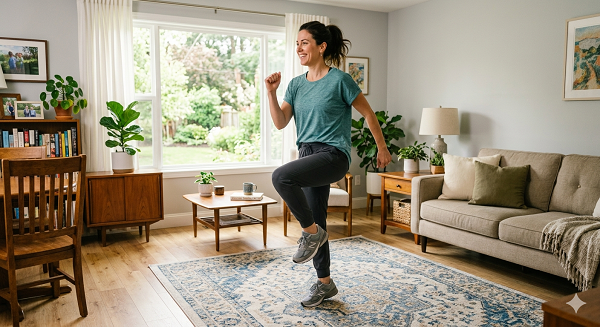
Marching Place
The Marching place is a gentle movement that helps to warm up the body and improve circulation.
Steps
1. Stand tall with your feet hip-width apart.
2. Lift one knee toward your chest.
3. Lower it and lift the other knee.
4. Continue marching slowly in place.
5. Swing your arms naturally as you move.
Tip
Please hold a wall or chair for balance if you do not feel steady.
2. Knee Push-Ups
This beginner-friendly version of a traditional push-up strengthens the chest, shoulders, and arms.
Steps
1. Start on your hands and knees on the floor.
2. Place your hands slightly wider than shoulder-width apart.
3. Keep your body in a straight line from head to knees.
4. Slowly lower your chest toward the floor.
5. Push back up to the starting position.
Tips
- Let your back be straight.
- Also Inhale as you lower your body and exhale as you push back up.
3. Chair Squats
Chair squats help strengthen the legs and hips, and they are similar to the movements of sitting and standing.
Steps
1. Stand in front of a sturdy chair.
2. Place your feet shoulder-width apart.
3. Slowly lower your hips toward the chair.
4. Lightly touch the seat.
5. Stand back up.
Tips
- Keep your chest upright and your eyes looking forward.
- Inhale as you lower into the squat and exhale as you stand up.
4. Stationary Lunges
Lunges help build strength in the thighs and improve balance.
Steps
1. Step forward with one leg.
2. Keep the back foot in place.
3. Slowly bend both knees and lower your body.
4. Press through the front foot to return to standing.
5. Repeat on the other side.
Tip
- Take a comfortable step forward so your front knee stays above your ankle.
5. Side-Lying Leg Raises
It strengthens the muscles around the hips.
Steps
1. Lie on your side with your legs straight.
2. Support your head with your arm if needed.
3. Slowly lift your top leg upward.
4. Lower it back down with control.
5. Repeat several times, then switch sides.
Why it helps
- Strong hip muscles help to improve balance and support the lower back.
6. Wall Plank
It is beginner-friendly and helps strengthen the core muscles that support posture.
Steps1. Stand facing a wall.
2. Place your forearms against the wall.
3. Step back slightly so your body forms a straight line.
4. Hold the position for 10–20 seconds.
Tip
- Keep your shoulders relaxed and avoid arching your back.
7. Heel Raises
A simple exercise that strengthens the calves and improves balance.
Steps
1. Stand behind a chair or counter for support.
2. Slowly lift your heels so you are standing on your toes.
3. Hold for a moment.
4. Lower your heels slowly.
Tip
- You can easily do this exercise while waiting for water to boil or during a phone call.
Safety Tips Before You Begin
Although these exercises are simple, it is still important to move safely.
- Start slowly: Begin with short sessions and gradually increase duration [2].
- Warm up: A few minutes of gentle marching or stretching prepares your muscles.
- Listen to your body: Mild soreness is normal; sharp pain is not. Stop if it hurts.
- Stay hydrated: Drink water before and after exercising.
- Use stable support: If you need balance, hold a sturdy chair or a wall.
- Measure your intensity: Use the “Talk Test.” During moderate activity, you should be able to talk but not sing. If you are gasping for breath, the activity may be too intense.
- Cool down: Spend 2–3 minutes walking slowly or gently stretching to help your heart rate return to normal.
- Stop exercising and seek medical advice if you experience chest pain, severe shortness of breath, or dizziness.
How to Make Exercise a Daily Habit
Starting is one thing, and sticking with it is another. Here are a few strategies to help make physical activity part of your routine [ 2].
- Start small: Even 5–10 minutes a day counts.
- Pick a regular time, such as after waking up or before dinner.
- Combine with daily activities: Exercise while watching TV, listening to music, or waiting for food to cook
- Track progress: To see if there are improvements in balance, strength, or energy.
- Involve family: Exercising together makes it more fun and keeps everyone motivated.
- Example: Try 3–4 days per week, 10–15 minutes per session, selecting a few home exercises. Gradually increase reps or duration as you feel stronger.
When to Speak to a Doctor
Most people can safely begin light exercise, but some individuals should talk with a healthcare professional first.You should consider seeking medical advice if you:
- Have heart disease or high blood pressure
- Have diabetes or any other chronic condition
- Experience chest pain or dizziness during activity
- Have severe joint problems or arthritis
- Are recovering from surgery or serious illness
- Are pregnant or have recently given birth and want guidance on safe exercises.
If you take medications for diabetes, high blood pressure, or other health conditions, speak with your healthcare provider before starting a new exercise routine. Physical activity may affect how these medicines work.
A healthcare professional can help you choose exercises that are safe for you.
Conclusion
Exercise does not need to be complicated, expensive, or time-consuming. Even small amounts of regular movement can improve your health and reduce the risk of chronic disease.The most important step is simply getting started. A few minutes of activity each day can make a difference over time.Start small, stay consistent, and let these simple home exercises help you build a healthier routine.
Frequently Asked Questions (FAQs)
1. How many minutes do I need to see results?
Adults should aim for 150 minutes of moderate activity per week (about 22 minutes a day).
2. Is it safe to exercise if I have a chronic condition like arthritis or diabetes?
Yes. Exercise helps lubricate joints, manage blood sugar, and improve overall health in people with chronic conditions. Start slowly and consult your healthcare provider for guidance on safe movements.
3. Can I lose weight by just doing these 7 home exercises?
These exercises build muscle and burn calories. For weight management, combine them with healthy eating, more vegetables, and less processed sugar for the best results.
4. What if I don’t have energy after work?
Even a 10-minute session, like marching in place, can boost circulation and oxygen levels, leaving you feeling more energised than if you were seated.
5. How do I know if I’m exercising at a moderate intensity?
Use the “Talk Test”: during moderate activity, you should be able to talk but not sing. If you can only say a few words without gasping, it’s vigorous intensity.
References
1. World Health Organization. Physical activity. 2024. Available from: https://www.who.int/news-room/fact-sheets/detail/physical-activity
2. Centers for Disease Control and Prevention. Steps for Getting Started With Physical Activity. 2025. Available from: https://www.cdc.gov/healthy-weight-growth/physical-activity/getting-started.html
3. Centers for Disease Control and Prevention. Benefits of Physical Activity. 2025. Available from: https://www.cdc.gov/physical-activity-basics/benefits/index.html
4. Dhuli K, Naureen Z, Medori MC, Fioretti F, Caruso P, Perrone MA, et al. Physical activity for health. J Prev Med Hyg. 2022;63(suppl.3):E150–E159. Available from: https://pmc.ncbi.nlm.nih.gov/articles/PMC9710390/#sec1-1
5. Kirk BJC, Mavropalias G, Blazevich AJ, Cochrane-Wilkie JL, Molan A, Nosaka K. Effects of a daily, home-based, 5-minute eccentric exercise program on physical fitness, body composition, and health in sedentary individuals. Eur J Appl Physiol. 2025 Aug;125(8):2241–2255. doi:10.1007/s00421-025-05757-7. Available from: https://pmc.ncbi.nlm.nih.gov/articles/PMC12354585/
Disclaimer:
The information provided on this website is for general educational and informational purposes only. It is not intended to replace professional medical advice, diagnosis, or treatment. Always seek the advice of your physician or other qualified health provider with any questions you may have regarding a medical condition.
Published March 23, 2026