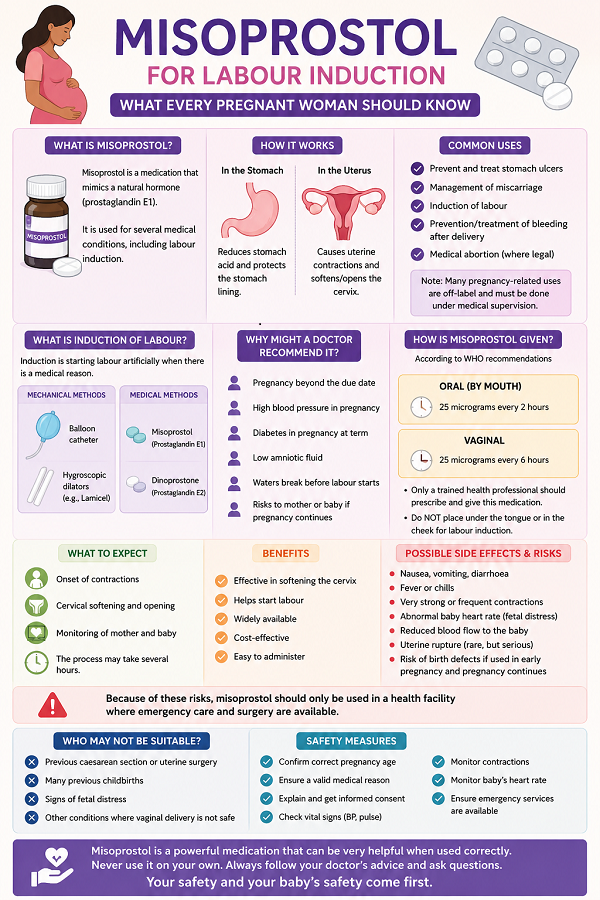
Misoprostol for Labour Induction: What Every Pregnant Woman Should Know
Author: Azuka Chinweokwu Ezeike, MBBS, FWACS, FMCOG, MSc (PH)
Highlights
- Misoprostol is a medication commonly used to induce labour when medically indicated.
- It works by softening the cervix and stimulating contractions.
- Misoprostol is effective, affordable, and widely available in many healthcare settings.
- Labour induction should only be carried out under the supervision of trained healthcare professionals.
- Serious complications can occur if misoprostol is used incorrectly or without proper monitoring.
- Never use misoprostol for labour induction at home without medical supervision.
Introduction
You may have heard that there are drugs that can make labour start or progress faster. Your neighbour, who has delivered three times, told you about the medications that helped her labour start and progress quickly during her pregnancies. Another friend mentioned the "hot injection" she received during labour, after which her baby arrived soon afterwards.
Now you are pregnant, and many of your friends whose expected delivery dates were around the same time as yours have already delivered. You are beginning to wonder whether you should ask your doctor about these medications because you are tired and eager to meet your baby. You may even be considering buying some of these drugs to keep at home while weighing your options.
Labour is a natural process that usually starts on its own. However, in some situations, healthcare providers may need to use artificial means to start labour. This process is called induction of labour [1]. Labour can be induced using medications or mechanical methods.One of the medications commonly used for labour induction is misoprostol.
Misoprostol is a drug originally used for stomach protection in non-pregnant people. It is also beneficial in the management of some pregnancy-related conditions.
This article explains how it works, its uses, safety considerations, and how it is used for labour induction.
What Is Misoprostol?
Misoprostol is a synthetic form of prostaglandin E1 [2]. Prostaglandins are hormonal substances naturally produced by the body. Misoprostol mimics the actions of natural prostaglandin E1 and can affect different organs, including the stomach and the womb (uterus).
Because of the potential risks associated with its use during pregnancy, misoprostol is a prescription-only medication in many countries, although it may be available over the counter in some settings.
How Does Misoprostol Work?
In the Stomach
Misoprostol helps create a protective mucus layer that prevents stomach damage and ulcers from acid. It also reduces the amount of acid produced by the stomach.
In the Uterus (Womb)
Misoprostol causes the muscles of the womb to contract [3]. It also softens and opens the cervix (the opening of the womb) by breaking down collagen fibres, making labour more likely to start and progress.
Common Medical Uses of Misoprostol
Misoprostol was originally developed to prevent and treat stomach ulcers. This remains its only use fully approved by the U.S.Food and Drug Administration (FDA) [2].
Over time, healthcare providers discovered that its effects on the womb could be useful in pregnancy care. As a result, it is now used for several pregnancy-related conditions.These uses include:
- Management of missed or incomplete miscarriage
- Induction of labour
- Prevention and treatment of bleeding after delivery (postpartum haemorrhage)
- Medical abortion in countries where abortion is legal and permitted by law. In the USA, It is FDA-approved for this purpose in conjuction with a second medication..
Many pregnancy-related uses of misoprostol are considered "off-label," meaning they are supported by evidence and professional guidelines but may not appear on the manufacturer's original licence. Such uses should only be carried out under the supervision of trained healthcare professionals.
What Does Induction of Labour Mean?
Induction of labour is the process of starting labour artificially rather than waiting for labour to begin naturally [2].
It is a medical procedure that should only be performed when there is a valid medical reason. Induction is recommended when continuing the pregnancy may pose a greater risk to the mother, the baby, or both.
There are two main methods of labour induction:[4]
Mechanical Methods
These include:
- Balloon catheter
- Hygroscopic dilators (such as Dilapan)
Medical Methods
These include medications such as:
- Misoprostol (Prostaglandin E1)
- Dinoprostone (Prostaglandin E2)
Why Might a Doctor Recommend Misoprostol?
Your doctor may recommend labour induction with misoprostol if: [1]
- Your pregnancy has gone beyond the expected due date.
- You have high blood pressure during pregnancy.
- You have diabetes and have reached term.
- Your baby's growth or well-being requires delivery.
- There is reduced amniotic fluid around the baby.
- Your waters break before labour starts.
How Is Misoprostol Given During Labour Induction?
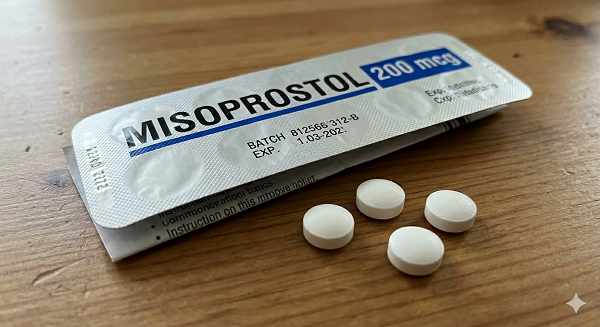
Misoprostol is commonly available as 200 microgram (mcg) tablets.
In some countries, lower-dose preparations (25 and 50mcg) are not readily available, so tablets may need to be divided carefully by healthcare professionals.
According to the World Health Organization (WHO), misoprostol may be used for labour induction in the following doses:
Oral Administration (By Mouth)
- 25 micrograms every 2 hours
Vaginal Administration (Inserted into the Vagina)
- 25 micrograms every 6 hours
These doses should only be prescribed and administered by trained healthcare professionals in an appropriate healthcare facility where both mother and baby can be monitored closely.
For labour induction, misoprostol should never be placed under the tongue or inside the cheek.
These routes may cause the drug to enter the bloodstream too quickly and increase the risk of excessive contractions and other complications.
What Should You Expect After Receiving Misoprostol?
After receiving misoprostol, you may experience: [2]
- Gradual onset of contractions
- Softening and opening of the cervix
- A waiting period that may last some hours before active labour begins
The time it takes for labour to start varies from one woman to another.
Benefits of Misoprostol for Labour Induction
Misoprostol offers several advantages: [5]
- Effective in softening and dilating the cervix
- Helps initiate labour
- Widely available in many settings
- Relatively affordable
- Easy to administer
Possible Side Effects and Risks of Misoprostol
Although misoprostol is a valuable medication, it can sometimes cause serious side effects.
In rare situations, complications may threaten the life of the mother, the baby, or both. This is why it should only be used under proper medical supervision.
Possible side effects and risks include: [2]
- Nausea and vomiting
- Fever or chills
- Diarrhoea
- Very strong or frequent contractions (uterine hyperstimulation)
- Abnormal fetal heart rate patterns (fetal distress)
- Reduced blood flow to the placenta due to excessive contractions
- Uterine rupture, especially in high-risk women
Because of these risks, misoprostol should ideally be used in facilities where emergency surgical services are available.
Who May Not Be Suitable for Misoprostol?
Misoprostol may not be appropriate for every pregnant woman.
It is generally avoided in women who have: [2]
- A previous caesarean section or other womb surgery
- Had many previous childbirths (grand multiparity)
- Signs of fetal distress (abnormal baby’s heart rate) before induction
- Certain conditions where vaginal delivery is not recommended
Your doctor will evaluate your individual circumstances before recommending its use.
Safety Measures During the Use of Misoprostol
When misoprostol is used for labour induction, careful monitoring by your health care professional is essential.This includes:
- Confirming the correct gestational age of the pregnancy
- Ensuring there is a valid medical reason for induction
- Explaining the procedure and obtaining informed consent
- Checking your blood pressure, pulse, and general well-being
- Monitoring contractions regularly
- Monitoring your baby's heart rate
- Ensuring emergency surgical services are available if needed
WATCH THE YOUTUBE VIDEO HERE
Conclusion
Misoprostol is an important medication that has transformed the management of several pregnancy-related conditions, including labour induction. Although its use for labour induction is considered off-label in many settings, it is supported by scientific evidence and recognised by major professional and regulatory bodies.
Like all medications, misoprostol has advantages and disadvantages. When used appropriately by trained healthcare professionals, it can be highly effective and safe. However, incorrect use may lead to serious complications for both mother and baby.
If your doctor recommends misoprostol, do not hesitate to ask questions and discuss any concerns you may have. Your healthcare team will assess whether you are a suitable candidate and will monitor you closely throughout the process.
Frequently Asked Questions (FAQs)
1. Can I buy Misoprostol and use it at Home to Start Labour?
No. Misoprostol should only be used under the supervision of trained healthcare professionals because it can cause serious complications if used incorrectly.
2. How Long Does it Take for labour to Start after Taking Misoprostol?
The timing varies from person to person. Some women develop contractions within a few hours, while others may require additional doses or other induction methods.
3. Is Misoprostol Safe for all Pregnant Women?
No. Women with a previous womb surgery or certain high-risk conditions may not be suitable candidates. Your doctor will assess your individual situation.
References
- Jenkins SM, Van Hook JW. Induction of Labor. In: StatPearls [Internet]. Treasure Island (FL): StatPearls Publishing; 2026 [cited 2026 Jun 12]. Available from: http://www.ncbi.nlm.nih.gov/books/NBK459264/ PubMed PMID: 29083625.
- Krugh M, Patel P, Maani CV. Misoprostol. In: StatPearls [Internet]. Treasure Island (FL): StatPearls Publishing; 2026 [cited 2026 Jun 12]. Available from: http://www.ncbi.nlm.nih.gov/books/NBK539873/ PubMed PMID: 30969695.
- Chatsis V, Frey N. Misoprostol for Cervical Ripening and Induction of Labour: A Review of Clinical Effectiveness, Cost-Effectiveness and Guidelines [Internet]. Ottawa (ON): Canadian Agency for Drugs and Technologies in Health; 2018 [cited 2026 Jun 12]. (CADTH Rapid Response Reports). Available from: http://www.ncbi.nlm.nih.gov/books/NBK538944/ PubMed PMID: 30907996.
- Weeks AD, Lightly K, Mol BW, Frohlich J, Pontefract S, Williams MJ, et al. Evaluating misoprostol and mechanical methods for induction of labour: Scientific Impact Paper No. 68 April 2022. BJOG. 2022 Jul;129(8). doi:10.1111/1471-0528.17136. Available from: https://pubmed.ncbi.nlm.nih.gov/35478481/
- Kerr RS, Kumar N, Williams MJ, Cuthbert A, Aflaifel N, Haas DM, et al. Low-dose oral misoprostol for induction of labour. Cochrane Database Syst Rev. 2021 Jun 22;6(6):CD014484. doi:10.1002/14651858.CD014484 PubMed PMID: 34155622; PubMed Central PMCID: PMC8218159. Available from: https://pubmed.ncbi.nlm.nih.gov/34155622/
Disclaimer:
The information provided on this website is for general educational and informational purposes only. It is not intended to replace professional medical advice, diagnosis, or treatment. Always seek the advice of your physician or other qualified health provider with any questions you may have regarding a medical condition.
Published June 13, 2026