How to Help a Choking Child: First Aid Steps

Author: Shibrah Rafaqat, MBBS
Medical Reviewer: Azuka Chinweokwu Ezeike, MBBS, FWACS, FMCOG, MSc (PH)
Highlights
- Choking is an emergency, but calm, quick action can save a child's life.
- If your child can cough, cry or speak, encourage them to keep coughing.
- If they cannot, give up to five back blows, then up to five abdominal thrusts (chest thrusts for babies under one).
- Call for emergency help if the object does not come out.
- Start CPR if your child becomes unresponsive.
- Cutting food safely and staying with children while they eat prevents many choking incidents.
Introduction
As a parent, you hope you’ll never have to face this. Your two-year-old is happily working through a bowl of grapes, and then she suddenly goes quiet. You look over and see her with wide eyes and a hand at her throat.It’s one of the most frightening things a parent can see, and it can happen within seconds in an ordinary kitchen on an ordinary day. Choking means something has blocked the airway and has stopped air from getting to the lungs. Airway obstruction is the leading cause of unintentional injury-related death among children younger than 1 year of age, and is mostly because of food, coins and small toys [1].
Because a child’s airway is much narrower than an adult’s, even a small piece of food can cause a serious blockage, and they can lose consciousness very quickly [2]. That’s why the first few minutes matter. In fact, clearing the blockage before help arrives is closely linked to survival [3].
The reassuring part is that the first aid is simple, and you don’t need medical training to help. This guide covers how to recognise choking, what to do step by step, what to avoid, and how to make it less likely in the first place.
What Is Choking?
Choking means that a foreign object is stuck in the throat or windpipe and is partly or fully blocking airflow. Usually it is food. Sometimes it is a small toy or a coin.
- Partial blockage (mild choking): Some air still gets through. Your child is able to cough, cry or speak, even if they sound distressed.
- Complete blockage (severe choking): Little or no air passes through. Your child cannot cough, speak or breathe at all.
Without air, oxygen cannot reach the lungs, and therefore cannot reach the brain and heart. This is why severe choking needs immediate first aid; it rarely resolves on its own.
What Causes Choking in Children?
Young children explore the world with their mouths, and their airways are small. They are also still learning to chew and swallow, so choking is more likely, especially in children under five.Worldwide, around 110 in every 100,000 children under five had a choking accident in 2019 [4].
A review of studies from many countries found that nuts and other food items are the objects children inhale most often [5]. Nigerian hospital records show the same pattern. In a six-year review at Aminu Kano Teaching Hospital, 20 of the 35 children treated for inhaled objects (57%) were under six years old. Groundnuts and whistles were the most common objects, at 25.7% each [6].
Common Food Causes
- Whole grapes, cherry tomatoes and other round, smooth foods
- Whole nuts (peanuts), popcorn and hard sweets
- Chunks of raw apple or carrot, sausages and large lumps of cheese
A large children hospital study found that peanuts caused the most food-related airway injuries, that children under three were at greatest risk, and that hard, round, slippery foods were the most dangerous [7]. Doctors in Aberdeen reported that grapes are the third most common food cause of choking in under-fives, behind hot dogs and sweets. Many parents are unaware of the danger [8].
Common Non-Food Causes
- Small toys or parts of toys, coins, buttons and balloon pieces [1]
- Pen lids and household items within a child’s reach
Situations That Raise the Risk
- Eating while running, laughing, crying or lying down
- Eating without an adult nearby
- Putting too much food in the mouth at once, even when the pieces are small
What Are the Signs of Choking?
If your child can cough, cry or speak, air is still getting through, so let them keep coughing. If they can’t, they need help straight away. This is the approach the NHS uses to tell mild choking from severe choking.
Signs of Mild Choking (Effective Cough)
- They can cry or talk
- They are coughing loudly
- They can take a breath in before coughing
- They are alert and responding to you
In this case, stay close, keep calm and encourage them to keep coughing. It is tempting to thump their back, but at this stage you are better off leaving them to it.
Signs of Severe Choking (Ineffective Cough)
- They cannot speak, cry or breathe
- The cough is silent, weak or absent
- They are clutching at their throat and look frightened
- They are struggling for breath, with a high-pitched noise or no sound at all
- Their lips or face are turning blue or grey
- They are going floppy or becoming unresponsive [9]
If you see these signs, do not wait. Start first aid.
What First Aid Should You Give a Choking Child?
These steps are for a child over one year old. Babies under one need a different technique, described after this section. Follow the steps in order and check after each one to see if the object causing the choking has come out. Sometimes the first back blow does it.
A Canadian study of real-life choking incidents (in adults and children) found that back blows were linked to better odds of clearing the blockage than abdominal thrusts, with no injuries attributed to back blows [3].
Step 1: Encourage Coughing
If your child is conscious and can cough, let them. Coughing is the body’s best way to clear a blockage, and it is more effective than anything you can do with your hands.
Step 2: Give Up to Five Back Blows
If coughing is not working:
- Lean your child forward and support their chest with one hand. For a small child, lay them face down across your lap.
- With the heel of your other hand, give a firm, sharp blow in the middle of the back, between the shoulder blades.
- Check their mouth after each blow. You may not need all five.
Step 3: Give Up to Five Abdominal Thrusts (Heimlich Maneuver)
If back blows have not worked and your child is still conscious:
- Stand or kneel behind the child and put your arms around their upper tummy.
- Make a fist and place it between the belly button and the bottom of the breastbone (the ribcage).
- Hold that fist with your other hand and pull sharply inwards and upwards.
- Repeat up to five times, checking each time.
Step 4: Call for Help
If the object has not come out after back blows and abdominal thrusts, call your local emergency number and report that a child is choking. If someone else is with you, ask them to call while you continue. If you are alone, shout for help and put the phone on speaker. Try not to leave the child.
Step 5: Keep Going
Continue alternating five back blows and five abdominal thrusts until the object comes out, help arrives, or your child stops responding.
For Babies Under One Year
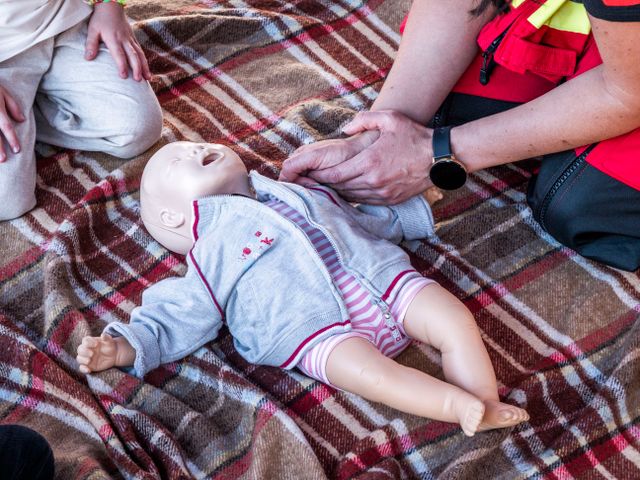
Do not give abdominal thrusts to babies. Instead, lay the baby face down along your forearm or thigh, supporting the head. The head should be lower than the chest. Give up to five back blows. If that fails, turn them over and give up to five chest thrusts using two fingers on the breastbone [9].
After the Object Comes Out
Even if your child seems fine afterwards, you should take them to a doctor if they have a persistent cough, difficulty swallowing, or feel as if something is still stuck. Anyone who has had abdominal thrusts should also be seen, because thrusts can sometimes cause internal injury.
What Should You Do If a Choking Child Becomes Unresponsive?
If your child stops responding, goes limp, and is not breathing normally, they need CPR immediately.
- Call for help: Dial your emergency number or shout for someone else to do it.
- Open the airway: Lay your child on their back and gently tilt the head back and lift the chin.
- Check the mouth: If you can clearly see the object, remove it. Do not search blindly.
- Give five rescue breaths: Pinch the nose, seal your mouth over theirs and blow steadily until the chest rises.
- Start chest compressions: Press down on the centre of the chest by about one third of its depth, then give two breaths for every 30 compressions.
- Continue until help arrives or your child starts to breathe normally [9].
If you have never learned CPR, a short paediatric first aid course is one of the best investments you can make as a parent or caretaker. A couple of hours of practice on a mannequin is much more useful than reading about it.
What Should You Not Do When a Child Is Choking?
In a panic, it is easy to do things that make matters worse. Avoid the following:
- Do not put your fingers blindly into the mouth. You can easily push the object deeper, and a frightened child may bite. Only remove an object you can clearly see [6].
- Do not give food, drink or water. A child who cannot breathe cannot swallow safely, and liquids can make the blockage worse.
- Do not hold the child upside down or shake them. This is not a recognised first aid technique and may cause harm.
- Do not hit the back of a child who is coughing well. It may move the object into a worse position.
- Do not give abdominal thrusts to a baby under one. Only use back blows and chest thrusts [9].
- Do not walk away to fetch help while your child is still choking.
How Can Choking in Children Be Prevented?
You cannot realistically remove every risk, but choking incidents are preventable with a few habits. Here is a home safety checklist parents can follow to protect children from accidents in their homes.
Prepare Food Safely
- Cut grapes, cherry tomatoes and similar round foods in half lengthways, then cut each half in half again so you have quarters [8].
- Slice sausages, hot dogs and cheese into strips, not rounds or chunks.
- Slice hard fruit and vegetables thinly or grate them.
- Do not give whole nuts to children under five.
- Avoid popcorn, marshmallows and boiled sweets for young children.
Make Mealtimes Safer
- Always stay with your child while they eat.
- Have them sit down, and avoid eating in the car, while running or when playing.
- Encourage small bites and slow chewing.
Keep Small Objects Out of Reach
- Look for small or loose parts on toys, and follow the age guidance on packaging.
- Keep coins, batteries, magnets and balloons away from young children. If you think a child has swallowed a button battery or magnet, go to the emergency department immediately, even if they seem perfectly well.
Learn First Aid
- Take a paediatric first aid course, or use a free app from a recognised organisation, and refresh your skills every so often.
Conclusion
Choking is scary, and nobody expects you to feel calm. But you must not panic. If your child can cough, encourage them. If they can’t, give up to five back blows, then up to five abdominal thrusts (chest thrusts for babies), and call for help. If they stop responding, start CPR. Most importantly, prevention matters. Simple habits like cutting food safely and staying close at mealtimes protect your child every day.
Frequently Asked Questions (FAQs)
Is it okay to give a child water if they are choking?
No. Water will not dislodge an object and may make things worse. Encourage coughing and follow the first aid steps.
Should I try to reach into my child’s mouth?
Only if you can clearly see the object and can remove it easily. Never sweep blindly with your fingers, as you could push it deeper.
My child coughed up the object and seems fine. Do I still need a doctor?
If your child is breathing normally and has no cough, pain or trouble swallowing, they are usually fine. However, see a doctor urgently if any of these symptoms persist, or if you have given them abdominal thrusts.
At what age do children stop being at high risk of choking?
Risk is highest in children under five, but it never fully disappears. Continue to supervise mealtimes and cut up large chunks of food.
Can I practise abdominal thrusts on a friend or child?
No. Practising on a real person can cause injury. An accredited first aid course will have you practice on a mannequin.
References
- Committee on Injury, Violence, and Poison Prevention. Prevention of choking among children. Pediatrics. 2010;125(3):601-7. doi:10.1542/peds.2009-2862. Available from: https://doi.org/10.1542/peds.2009-2862
- Bielinski JR, Huntley R, et al. Do we actually help choking children? The quality of evidence on the effectiveness and safety of first aid rescue manoeuvres: a narrative review. Medicina (Kaunas). 2024;60(11):1827. doi:10.3390/medicina60111827. Available from: https://www.mdpi.com/1648-9144/60/11/1827
- Dunne CL, Cirone J, Blanchard IE, Holroyd-Leduc J, Wilson TA, Sauro K, et al. Evaluation of basic life support interventions for foreign body airway obstructions: a population-based cohort study. Resuscitation. 2024;201:110258. doi:10.1016/j.resuscitation.2024.110258. Available from: https://pubmed.ncbi.nlm.nih.gov/38825222/
- Wu Y, Zhang X, Lin Z, Ding C, Wu Y, Chen Y, et al. Changes in the global burden of foreign body aspiration among under-5 children from 1990 to 2019. Front Pediatr. 2023;11:1235308. doi:10.3389/fped.2023.1235308. Available from: https://pubmed.ncbi.nlm.nih.gov/37727616/
- Foltran F, Ballali S, Rodriguez H, van As AB, Passali D, Gulati A, et al. Inhaled foreign bodies in children: a global perspective on their epidemiological, clinical, and preventive aspects. Pediatr Pulmonol. 2013;48(4):344-51. doi:10.1002/ppul.22701. Available from: https://pubmed.ncbi.nlm.nih.gov/23169545/
- Ahmed AO, Shuaibu IY. Inhaled foreign bodies in a paediatric population at AKTH Kano-Nigeria. Niger Med J. 2014;55(1):77-80. doi:10.4103/0300-1652.128178. Available from: https://pmc.ncbi.nlm.nih.gov/articles/PMC4071669
- Altkorn R, Chen X, Milkovich S, Stool D, Rider G, Bailey CM, et al. Fatal and non-fatal food injuries among children (aged 0-14 years). Int J Pediatr Otorhinolaryngol. 2008;72(7):1041-6. doi:10.1016/j.ijporl.2008.03.010. Available from: https://pubmed.ncbi.nlm.nih.gov/18455807/
- Lumsden AJ, Cooper JG. The choking hazard of grapes: a plea for awareness. Arch Dis Child. 2017;102(5):473-4. Available from: https://abdn.elsevierpure.com/en/publications/the-choking-hazard-of-grapes-a-plea-for-awareness
- Van de Voorde P, Turner NM, Djakow J, de Lucas N, Martinez-Mejias A, Biarent D, et al. European Resuscitation Council Guidelines 2021: Paediatric Life Support. Resuscitation. 2021;161:327-87. doi:10.1016/j.resuscitation.2021.02.015. Available from: https://pubmed.ncbi.nlm.nih.gov/33773830/
Disclaimer:
The information provided on this website is for general educational and informational purposes only. It is not intended to replace professional medical advice, diagnosis, or treatment. Always seek the advice of your physician or other qualified health provider with any questions you may have regarding a medical condition.
Published November 18, 2026