How Does Endometriosis Affect Fertility?
Author: Azibayam Okrinya, MBBS
Medical Reviewer: Azuka Chinweokwu Ezeike, MBBS, FWACS, FMCOG, MSc (PH)
Highlights
- Endometriosis is a condition where tissue that lines the womb grows outside the womb.
- You should suspect you have endometriosis if you are having: very painful menstruation, lower abdominal pain, pain during sex, heavy menstruation and difficulty getting pregnant.
- Endometriosis affects fertility by causing damage to female reproductive organs, making it difficult for the woman to get pregnant.
- Women who have endometriosis may find it more difficult to get pregnant
- With the right care and treatment, some women with endometriosis may achieve pregnancy.
Introduction
Can a woman get pregnant if she has endometriosis? This is a serious concern for women who have endometriosis. Especially if they have been trying to get pregnant or plan to have children in the near future.
While endometriosis can make it more difficult for you to get pregnant, it doesn't mean it is impossible. Some women with endometriosis get pregnant naturally, and for those who find it difficult, with the right treatment, most of them can get pregnant.
In this article, we’ll answer your questions on what endometriosis is, how it affects fertility and the treatment options available for women who wish to conceive.
What Is Endometriosis?
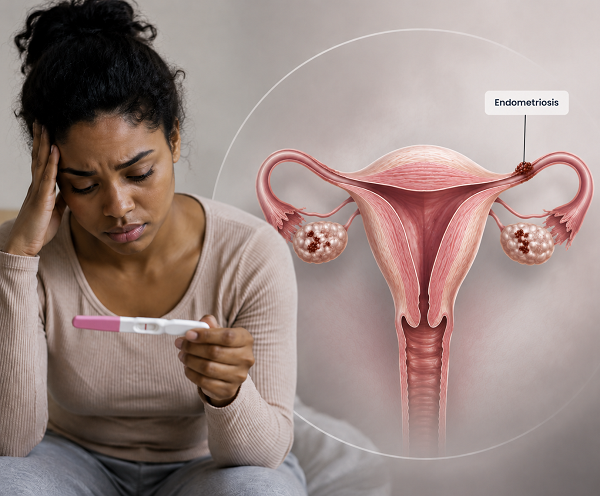
Endometriosis happens when tissue that lines your womb (uterus) grows outside the womb, causing some issues in your body [1].Endometriosis can occur in the following locations:
- The ovary, where the female eggs are produced
- The fallopian tube, which carries the egg from the ovary to the womb.
- Pelvic peritoneum, which covers the lower abdominal tissues.
- Other locations: rectum, bladder, intestines, lungs, cervix, vagina, etc.
According to the World Health Organization (WHO), about 10% (190 million) of women worldwide who are of reproductive age suffer from endometriosis, regardless of their status or where they are from. Endometriosis affects anybody who menstruates, including transgender men [1].
What Causes Endometriosis?
The exact cause of endometriosis is not known; however, recent studies suggest it may be due to menstrual blood backflow and malfunction of the system that fights infection and protects the body [1,2].
Although the exact cause of endometriosis is not known, some factors increase your risk of having endometriosis, such as:
- Having a family member who has endometriosis.
- Having short monthly menstrual cycles (less than 21 days)
- Having long and heavy menstruation (more than 7 days).
- Having your first menstruation at an early age (before age 11).
- Other factors: not having any children and low body weight.
What Are the Symptoms of Endometriosis?
When the tissue that lines your womb grows in the wrong place, it can cause:
- Very painful menstruation.
- Lower abdominal and back pain.
- Heavy menstruation.
- Inability to get pregnant (infertility).
- Pain during sex.
- Pain when urinating or defecating.
While many cases of endometriosis present with symptoms, you can also have endometriosis and not know until you have difficulty getting pregnant.
How Is Endometriosis Diagnosed?
If you notice any symptoms and see a doctor, the doctor will make a diagnosis by asking you some questions, performing a pelvic examination, and requesting an ultrasound scan (USS) or a Magnetic resonance imaging (MRI).The test that is used to confirm endometriosis is laparoscopy.
Can You Get Pregnant if You Have Endometriosis?
The answer is yes; you can get pregnant. You may have difficulties, but with the right treatment, you will be able to achieve pregnancy.A recent study on Infertility and endometriosis showed that a total of 40.5% of women with an endometriosis diagnosis had at least one pregnancy during the study period [3].
Another study on the rate of pregnancy success after endometriosis surgery showed that surgery increased the fertility rate considerably [4].
How Does Endometriosis Affect Fertility?
Endometriosis is a known cause of infertility worldwide; among women with infertility, as many as 25–50% have endometriosis.The exact way in which endometriosis is linked to infertility is not fully understood. Experts believe there are several ways in which it may make it difficult for a woman to get pregnant. However, more research is needed to better understand these links [5].These are the possible ways in which endometriosis causes infertility:
- Structural Changes In the Pelvis:
Endometriosis can cause the formation of scar tissue (adhesions) and changes in the structure of the ovary and fallopian tube, which can affect ovulation, fallopian tube function, and embryo transport [6].
- Altered Pelvic Tissue and Fluid Function:
Endometriosis causes inflammation in the pelvis and increases the levels of inflammatory substances in the fluid surrounding the pelvic organs. These changes may damage the egg, sperm or embryo, thereby affecting the quality of the egg, fertilisation and embryo development[5,6].
- Altered Immune Function:
The cells that fight infection and protect the body may be increased in the lining of the womb of women who have endometriosis; this can make it harder for an embryo to attach to the womb [5,6].
- Hormone and Ovulation Problems:
Endometriosis may cause hormonal imbalance, which may affect the menstrual cycle and interfere with the regular release of the egg (ovulation), making it hard for pregnancy to occur [5].
- Abnormal Implantation:
After fertilisation takes place, the embryo that is formed needs to attach to the lining of the womb (implantation) for pregnancy to begin. Endometriosis causes changes in this lining, which makes this process more difficult [5,6].
- Egg and Embryo Quality:
Endometriosis may reduce the quality of a woman's eggs; as a result, even if the egg is fertilised, it may not develop properly, reducing the chances of a successful pregnancy [5].
- Abnormal (Womb) Uterus and Fallopian Tube Transportation:
Endometriosis may affect the normal movement of the egg or fertilised egg; this can make it difficult for the egg and sperm to meet or for the fertilised egg to reach the uterus, thereby reducing the chances of pregnancy [5].
- Pain During Sex (Dyspareunia):
One of the symptoms of endometriosis is pain during sex. This discomfort may cause couples to have sex less often, reducing the chances of pregnancy by limiting the opportunities for fertilisation.
Stages of Endometriosis
Staging of endometriosis is very important, as the stage determines the kind of treatment you will receive [6].According to the American Society for Reproductive Medicine (ASRM), endometriosis has four stages.
- Stage 1 (minimal)
- Stage 2 (mild)
- Stage 3 (moderate)
- Stage 4 (severe)
The higher the stage, the higher the chances of infertility.
Treatment for Endometriosis-Associated Infertility
Even if there is no cure for endometriosis, a woman with infertility caused by endometriosis can get pregnant with appropriate treatment.Treatment is based on:
- Your age
- Duration of infertility
- Ovarian reserve
- Stage of the disease
- Previous treatments
The treatment for endometriosis-associated infertility includes: conservative management, surgical treatment, and fertility treatments [7].
Conservative Management
If you have stage 1 or 2 endometriosis, you may still be able to get pregnant without any medical or surgical treatment [7], so doctors may simply monitor your condition.
Surgical Treatment
If you have more severe disease, i.e. stage 3 or 4, pregnancy rates are lower. Therefore, your doctor may recommend surgical removal of the endometriosis lesions to improve fertility.Surgery may also be recommended if conservative management doesn't work.
Fertility Treatments
You may also need to see a fertility doctor if you are having trouble getting pregnant, who may recommend assisted reproductive technologies (ART), such as in vitro fertilisation (IVF).Medications used to treat the disease itself prevent or reduce fertility and, as such, are not used for women who are trying to get pregnant, except in patients undergoing in vitro fertilisation (IVF) [7].
When To See a Doctor
If you have endometriosis and you are unable to get pregnant, make sure to speak to your doctor and ask about being referred to a gynaecologist and a fertility specialist.
Conclusion
Endometriosis can make it harder for some women to get pregnant; however, most of them can get pregnant with the right treatment. If you have difficulty getting pregnant due to endometriosis, you should see your doctor.
Frequently Asked Questions (FAQs)
Is it every woman with endometriosis that will have difficulty getting pregnant?
No. Some women with endometriosis do not have difficulty getting pregnant. However, some might need fertility treatment to be able to.
Does having surgery guarantee pregnancy?
No. Although surgery may improve fertility for some women, it doesn't guarantee pregnancy, as factors such as age also play an important role.
How long should I try to get pregnant before seeing a doctor?
If you have been trying to get pregnant for between 6 months and 1 year, you should see your doctor.
References
- World Health Organization.Endometriosis [Internet]. [cited 2026 Jul 20]. Available from: https://www.who.int/news-room/fact-sheets/detail/endometriosis
- Shifon S, Tyrinova T, Veretelnikova T, Pasman N, Chernykh E. Endometriosis as an immune-mediated disease: pathogenetic mechanisms and therapeutic strategies. Front Immunol. 2025 Dec 18;16. doi:10.3389/fimmu.2025.1727183. Available from: https://www.frontiersin.org/journals/immunology/articles/10.3389/fimmu.2025.1727183/full
- Saraswat L, Ayansina D, Nath M, Rytter D, Saunders P, Horne A. O-250 Infertility and endometriosis: a 30-year-long national population-based study of prevalence, association and pregnancy outcomes. In: Human Reproduction [Internet]. Oxford University Press; 2025 [cited 2026 Jul 21]. Available from: https://academic.oup.com/humrep/article/40/Supplement_1/deaf097.250/8182048
- Asgari Z, Hajiloo N, Hosseini R, Moini A, Valian Z, Mirzaei S, et al. Investigating The Rate of Pregnancy Success after Endometriosis Surgery in Infertile Patients with Advanced Endometriosis: A Retrospective Study. Int J Fertil Steril. 2025;19(2):241–5. doi:10.22074/ijfs.2024.2023666.1631 PubMed PMID: 40200784; PubMed Central PMCID: PMC11976877. Available from: https://pmc.ncbi.nlm.nih.gov/articles/PMC11976877/#sec11
- American Society of Reproductive Medicine. Endometriosis and infertility: a committee opinion (2012) [Internet]. [cited 2026 Jul 28]. Available from: https://www.asrm.org/practice-guidance/practice-committee-documents/endometriosis-and-infertility-a-committee-opinion-2012/
- Gniadek M, Porubenska A, Pełka K, Rzepkowska Z, Florjański J. Endometriosis-Associated Infertility: A Review of Pathophysiological Mechanisms and Current Treatment Strategies. JCM. 2026 Jun 2;15(11):4297 doi:10.3390/jcm15114297. Available from https://www.mdpi.com/2077-0383/15/11/4297
- Macer ML, Taylor HS. Endometriosis and Infertility: A review of the pathogenesis and treatment of endometriosis-associated infertility. Obstet Gynecol Clin North Am. 2012 Dec;39(4):535–49. doi:10.1016/j.ogc.2012.10.002 PubMed PMID: 23182559; PubMed Central PMCID: PMC3538128. Available from: https://pmc.ncbi.nlm.nih.gov/articles/PMC3538128/#S12
Disclaimer:
The information provided on this website is for general educational and informational purposes only. It is not intended to replace professional medical advice, diagnosis, or treatment. Always seek the advice of your physician or other qualified health provider with any questions you may have regarding a medical condition.
Published July 29, 2026