Having a CT Scan? Here’s What to Expect
Medical Writer: Oke Ikpekpe, MSc (PH)
Medical Reviewer: Nnenna Chiloli, MBBS, MPH
Highlights
- A CT scan uses X-ray and computer technology to create images of the inside of your body.
- Your healthcare provider may recommend a CT scan to investigate symptoms, diagnose conditions, or monitor treatment.
- Some CT scans use a contrast dye to make certain organs, blood vessels, or tissues easier to see.
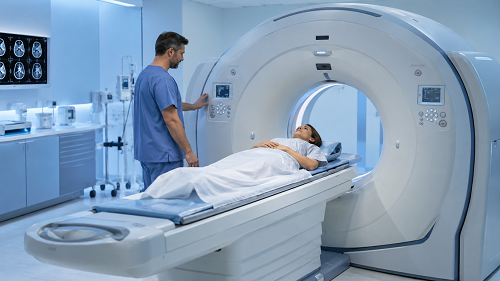
- During the scan, you will lie still on a table that moves through a large, doughnut-shaped scanner.
- CT scans are generally quick and painless.
- Unless you receive sedation or need additional care, you can usually go home afterwards.
Introduction
If your doctor has recommended a CT scan, you may be wondering why you need it, what will happen during the examination, and whether it is safe.
A computed tomography (CT) scan, also called a CAT scan, uses X-rays to show detailed pictures of the inside of your body. Your doctor may recommend a CT scan to investigate symptoms, look for injuries or disease, or monitor how a condition is responding to treatment.The scan is usually painless, and most people can go home shortly after the examination [1,2].
How you prepare will depend on the part of your body being examined, whether you need contrast material, and your medical history [3].
This article will help you understand what a CT scan is, how it is performed, and what to expect during and after the procedure.
What Is a CT Scan?
A CT scan produces detailed images of structures inside your body, such as your bones, organs, soft tissues, and blood vessels [1,2].
Unlike a conventional X-ray, which produces a flat image, a CT scanner takes measurements from different angles around your body. A computer processes these measurements to create cross-sectional images, or slices, allowing doctors to examine the body one section at a time [2].
Doctors can use these images to identify problems and examine them more closely. The images can also be combined to create three-dimensional views when needed.
Why Is a CT Scan Done?
Your doctor might request a CT scan to investigate persistent symptoms, check for injuries, or examine an area where a medical problem is suspected [1,2].
The images are also used to:
Identify tumours and assess their size and location.
Assess the extent or spread of certain diseases, including cancer.
Plan surgery or radiation treatment.
See how a condition is responding to treatment.
Help guide procedures such as biopsies.
In an emergency, CT can show internal bleeding or damage to organs, such as severe head injury and suspected stroke, within a short time, giving doctors information they need to decide on treatment.
What Conditions Can a CT Scan Help Diagnose?
The conditions a CT scan can help identify depend on the part of your body being examined [1,2].
A CT scan cannot diagnose every condition; sometimes other tests may be needed to confirm what the images show.
How to Prepare for a CT Scan
Your healthcare team will tell you what to do before the examination. The instructions depend on the scan you are having [3,4].
- Wear comfortable clothing. You may need to change into a hospital gown.
- Remove jewellery, hairpins or other metal objects if the imaging team asks you to.
- Tell the team which medicines you take, particularly metformin, and follow the clinic's specific medication instructions. Do not stop prescribed medication unless instructed.
- Mention any possibility of pregnancy, kidney disease or previous reaction to contrast material. If you have kidney disease, the imaging team may review your kidney function before giving a contrast.
- Avoid food or drinks only if your appointment instructions tell you to fast.
- Tell your healthcare team if you have difficulty lying down, holding your breath, are in severe pain, or have intense fear about being in enclosed spaces.
What Happens During a CT Scan?
A radiographer will help you lie on a table that moves through the scanner’s short, ring-shaped opening. You may hear clicking or buzzing sounds and be asked to remain still or hold your breath briefly.The radiographer will be in an adjoining room but can see, hear and speak with you throughout the scan.
The scan is usually quick, but the entire appointment can take longer depending on preparation and contrast. The scan itself is painless, but you may feel a brief needle prick if contrast is injected [3].
What Happens After a CT Scan?
You may need to wait briefly while the team checks the images or observes you after contrast.Most people can leave and continue their usual activities afterwards. If you were given sedation, you will need time to recover and someone to take you home [3].
What Is Contrast Dye and When Is It Used?
Some CT scans use contrast material, commonly called contrast dye, to make certain organs, tissues and blood vessels easier to see. Depending on the examination, it may be injected into a vein, swallowed or, less commonly, given through the rectum [4].
Not every CT scan requires contrast [3]. Injected contrast may cause a brief warm sensation, metallic taste, or feeling that you need to urinate. Oral contrast may have an unusual taste, while rectal contrast may cause temporary fullness.Iodine-based contrast is usually given through a vein, while barium contrast is used to make parts of the digestive tract easier to see [4].
Understanding Your CT Scan Results
A radiologist is a doctor who specialises in reading medical images. They examine your scan, write a report, and send it to the doctor who requested the examination.The report may include:
- Normal findings.
- Any abnormalities seen.
- Areas the scan could not assess fully.
- Suggestions for further tests or follow-up.
Sometimes, another test is recommended because a finding needs a closer look or comparison over time. It does not automatically mean you have cancer. Do not diagnose yourself; ask your doctor, who will explain the results and any next steps.
What Are the Benefits of a CT Scan?
CT scans can provide information that would be difficult to obtain through a physical examination alone [1,2].
- They can reveal internal bleeding and serious injuries quickly.
- Doctors can examine bones, organs, and blood vessels in considerable detail.
- They provide a way to examine internal structures without surgery.
- The images can guide biopsies and other procedures.
- In some cases, the findings help doctors avoid unnecessary exploratory procedures.
What Are the Risks of a CT Scan?
CT scans are generally safe when medically necessary, but there are some risks to consider.
- CT scans use X-rays, which, depending on the radiation dose, body part exposed, age, and other factors, may slightly increase the risk of cancer later in life. Children are more sensitive to radiation, so healthcare professionals adjust the scanning settings to their size and the examination [1,5]. The scan does not make you radioactive, and no radiation remains in your body afterwards [2].
- Some patients may experience nausea, itching, or a rash after receiving contrast material. Serious reactions are uncommon, but people with severe kidney problems may need additional precautions before receiving injected contrast [4].
If you are pregnant or think you might be pregnant, tell your doctor before the scan. They may consider ultrasound or magnetic resonance imaging (MRI), although CT may still be necessary in some situations [2,3].
CT Scan vs MRI: What Is the Difference?
Both CT and magnetic resonance imaging (MRI) produce detailed images of the inside of your body, but they work differently [1,2,4].
Neither scan is suitable for every condition. Your doctor will recommend the examination that can provide the information needed for your care.
Conclusion
It is natural to have questions or feel a little nervous if your doctor recommends a CT scan. But the scan itself is usually quick and painless, and is generally safe when medically necessary. More importantly, the images can help your doctor understand what is happening inside your body and decide on the appropriate treatment.
Before your appointment, ask any questions you have and make sure you understand why the scan is needed and what will happen next.
Frequently Asked Questions (FAQs)
1. Can a CT scan detect cancer?
Yes. A CT scan can identify abnormalities that may suggest cancer and show their size and location. However, further tests, such as a biopsy, may be needed to confirm cancer.
2. Can I resume normal activities after a CT scan?
Yes. You can usually go home and resume your normal activities immediately. If you received sedation, follow your recovery instructions and arrange for someone to take you home.
3. Is contrast dye safe?
Most patients receive contrast without serious complications, although reactions can occur. Tell your healthcare team about kidney disease or previous contrast reactions. Seek emergency help if you develop difficulty breathing or swelling of your face or throat. Contrast material itself does not produce radiation.
4. Can I breastfeed after a CT scan with contrast?
Yes. You can usually continue breastfeeding after receiving iodine-based contrast for a CT scan. There is generally no need to express and discard your breast milk.
5. Can I have a CT scan if I have a pacemaker or implanted device?
A pacemaker or other implanted device generally does not prevent a CT scan. Tell your imaging team about the device so they can take any necessary precautions.
References
1. U.S. Food and Drug Administration. Computed tomography (CT) [Internet]. Silver Spring (MD): U.S. Food and Drug Administration; [cited 2026 Sep 20]. Available from: https://www.fda.gov/radiation-emitting-products/medical-x-ray-imaging/computed-tomography-ct
2. Radiological Society of North America, American College of Radiology. Body CT [Internet]. RadiologyInfo.org; 2026 Jun 15 [cited 2026 Sep 20]. Available from: https://www.radiologyinfo.org/en/info/bodyct
3. Radiological Society of North America, American College of Radiology. How to prepare for your CT exam [Internet]. RadiologyInfo.org; 2026 Jul 15 [cited 2026 Sep 20]. Available from: https://www.radiologyinfo.org/en/info/how-to-prepare-your-ct-exam
4. Radiological Society of North America, American College of Radiology. Contrast materials [Internet]. RadiologyInfo.org; 2024 Aug 25 [cited 2026 Sep 20]. Available from: https://www.radiologyinfo.org/en/info/safety-contrast
5. Smith-Bindman R, Chu PW, Azman Firdaus H, Stewart C, Malekhedayat M, Alber S, et al. Projected lifetime cancer risks from current computed tomography imaging. JAMA Intern Med [Internet]. 2025 Jun [cited 2026 Sep 20];185(6):710–719. doi:10.1001/jamainternmed.2025.0505. Available from: https://pmc.ncbi.nlm.nih.gov/articles/PMC11997853/
Disclaimer:
The information provided on this website is for general educational and informational purposes only. It is not intended to replace professional medical advice, diagnosis, or treatment. Always seek the advice of your physician or other qualified health provider with any questions you may have regarding a medical condition.
Published September 28, 2026