Multiple Myeloma: What Causes It and How Is It Treated?
Author: Jane Kareem (B.Sc.)
Medical Reviewer: Dr Nnenna Chiloli, MBBS, MPH
Highlights
- Multiple myeloma is a type of blood cancer where white blood cells called plasma cells multiply uncontrollably.
- The exact cause of multiple myeloma has not been established.
- People aged over 65, men, and those of African descent are at higher risk of multiple myeloma.
- The signs and symptoms of multiple myeloma include bone pain, back pain, anaemia, fatigue, and kidney damage.
- Chemotherapy, stem cell transplant, and radiotherapy are among the common multiple myeloma treatment options.
Introduction
Do you know that blood production in your body starts with cells deep within your bones? These stem cells are found in a special kind of tissue called the bone marrow. There, they develop into essential blood components like the red and white blood cells and platelets.
Plasma cells come from white blood cells called B lymphocytes. Their main job is to help your body fight against infections by producing antibodies. However, just like many other cells in the body, these plasma cells can undergo changes that cause them to multiply uncontrollably.
Over time, they accumulate and take up more space than usual, leaving little room for normal blood cells. This process disrupts the healthy environment within the bone marrow and affects blood production [1].
As the abnormal cells increase, they also damage the bones and produce harmful proteins that can affect vital organs, especially the kidneys [1]. This condition is called multiple myeloma, a type of blood cancer.The term ‘multiple’ is used because early descriptions of the disease noted that it affects the body at different sites where the bone marrow exists [2].
In this article, you’ll learn about the causes of multiple myeloma, its symptoms, and who is at risk for the disease. You’ll also discover how it is diagnosed and current treatment options.
Causes of Multiple Myeloma
According to the American Cancer Society, it’s not clear what causes multiple myeloma. However, certain risk factors have been identified that make a person more likely to develop the disease. These include:
- Genetic changes
- Age
- Obesity
- Exposure to chemicals like pesticides
Who is More Likely to Develop Multiple Myeloma?
More research into multiple myeloma has shown that the following people have a higher risk of developing the blood cancer [3]:
- People aged over 65
- Men
- People of African descent
- People with a family history, especially close relatives
What Are the Symptoms of Multiple Myeloma?
The symptoms of multiple myeloma, as noted by the International Myeloma Foundation, include:
- Persistent back pain
- Recurring bone pain
- Constant tiredness
- Frequent infections
- Unexplained weight loss
- Nausea and vomiting
- Fractures
However, note that some people living with multiple myeloma may not experience serious symptoms at first [4].
How is Multiple Myeloma Diagnosed?
Health professionals rely on multiple tests to confirm if a person has multiple myeloma. In 2003, the International Myeloma Working Group (IMWG) released the CRAB criteria to aid diagnosis [5]. These criteria are as follows:
- Calcium: A blood calcium level above 11 mg/dL or more than 1 mg/dL above the upper limit of normal is considered a red flag.
- Reduced Kidney Function: Urine tests showing creatinine clearance below 40 mL/min or serum creatinine above 2 mg/dL may point to multiple myeloma.
- Anaemia: This happens when the plasma cells crowd out the red blood cells. The IMWG flags test results showing haemoglobin level below 10 g/dL or more than 2 g/dL below the lower limit of normal.
- Bone Damage: The presence of at least one bone lesion on an X-ray or CT scan in patients with less than 10% clonal plasma cells is also notable. ‘Clonal’ simply means they all originate from the same parent cell.
However, these signs and symptoms typically occur when there has been extensive organ damage. This is why the organisation expanded the criteria to include the SLiM biomarkers in 2014 [6]. That acronym represents:
- S: At least 60% clonal plasma cells present in a bone marrow biopsy.
- Li: Light Chain Ratio, checking the balance of specific antibody fragments in the blood.
- M: More than one bone lesion measuring at least 5 mm, seen on a magnetic resonance imaging (MRI) scan.
The goal of the expanded criteria was to help health professionals to identify active multiple myeloma before it progresses further [6].Based on these, your doctor will require different multiple myeloma tests. They will check your blood and urine and do a scan before giving you a multiple myeloma diagnosis.
Blood Tests
Complete Blood Count
Multiple myeloma leads to anaemia because the plasma cells involved occupy more space than other essential blood cells [7]. A complete blood count helps to see the quantity of each cell type in your blood, making it easier to tell if there are abnormalities.
Blood Chemistry Profile
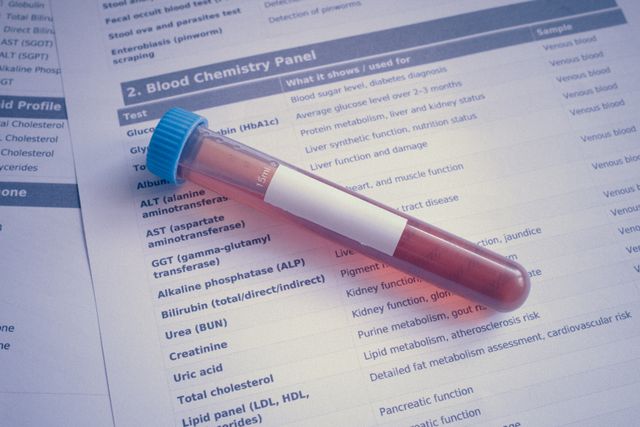
This is a test to measure the amount of substances like calcium and lactate dehydrogenase (LDH) in the blood. It is valuable because the destruction of the bone in multiple myeloma releases large amounts of calcium into the blood [8], while a high LDH level may indicate that the cancer cells are multiplying rapidly [9].Other blood components like albumin, serum creatinine, and blood urea nitrogen (BUN) may also be assessed [1].
Urine Tests
Urine Protein Electrophoresis (UPEP) Test
The abnormal plasma cells that lead to multiple myeloma create a specific type of protein called the M protein [1]. This test is done on urine samples collected over a 24-hour period to check if the protein is present.
Urine Immunofixation
This test reveals what type of proteins and antibody fragments are present in a urine sample, helping to confirm if they’re those linked to multiple myeloma [1]. The antibody fragments are known as Bence Jones proteins.
Bone Marrow Biopsy
In this test, cells are taken from your bone marrow using a large needle. It helps professionals to look at them directly and perform further tests that help them to assess your condition.
Scans
Another way for medical professionals to look into what is going on in your body is through scans. Due to the effects of multiple myeloma on the bone, scans can provide a picture of the affected areas of the body and the extent of the damage [1]. These scans include:
- X-ray
- Magnetic Resonance Imaging (MRI)
- Positron Emission Tomography (PET)
- Computed Tomography (CT)
What are the warning Signs of Multiple Myeloma
Seek medical care if you notice any of the following:
- New or severe back pain accompanied by leg weakness, numbness, or difficulty walking
- Sudden loss of bladder or bowel control
- Confusion or marked drowsiness
- Severe breathlessness
How Is Multiple Myeloma Treated?
Multiple myeloma is a disease with no definitive cure, but there are now multiple treatment options that can help to improve patients' lives [3]. While making a treatment plan, doctors consider factors like:
- Age
- Fitness
- The stage of the cancer
- The location of the cancer
- Overall health
- Ability to tolerate side effects
In some cases, the multiple myeloma treatment plan occurs in different stages [3]. They are described as:
- Induction Therapy: It prioritises killing off most of the cancer cells and relieving symptoms.
- Consolidation Therapy: It involves a secondary treatment option to destroy more remaining cancer cells.
- Maintenance/Extended Therapy: Its goal is to prevent signs and symptoms from recurring and keep patients in remission for longer.
The following treatment plans fall within one of these three treatment stages:
Medications
Drugs are used to target the cancer cells in particular during induction therapy [1]. There are different classes of these drugs used, such as:
- Proteasome inhibitors, e.g., bortezomib
- Immunomodulatory drugs, e.g., lenalidomide
- Monoclonal antibodies, e.g., daratumumab
Some of these drugs are also used during the maintenance therapy stage of treatment.
High-Dose Chemotherapy
Also considered part of induction therapy, chemotherapy is a key part of the treatment plan for many newly diagnosed patients [10]. It may also be used in later stages of the treatment plan. Examples of the drugs involved here are:
- Melphalan
- Doxorubicin
- Bendamustine
- Vincristine
The exact drug combination depends on your treatment plan and whether you qualify for a stem cell transplant.
Stem Cell Transplant
Another treatment option for multiple myeloma involves transferring new healthy stem cells into the bone marrow. It is known as a stem cell transplant and usually occurs after chemotherapy as consolidation therapy.This procedure replaces the abnormal cells with healthy ones for better blood production. It may be done using your own stem cells or a donor’s [1].
Chimeric Antigen Receptor (CAR) T Cell Therapy
CAR T cell therapy is a newer treatment option for blood cancers like multiple myeloma. Here, another type of blood cell called the T cell is altered in a lab and introduced to your body to find and kill the cancer cells [10].
Radiotherapy
In this mode of treatment, X-rays are used to kill abnormal plasma cells in specific locations. It is often used for patients experiencing serious damage and pain due to the cancer. Radiotherapy may also be used to prevent serious complications [10].
Can Multiple Myeloma Be Prevented/Detected Early?
According to the Cancer Research Institute, there is currently no known way to prevent multiple myeloma. This is largely because a direct cause hasn’t been identified.However, the following conditions that can lead to multiple myeloma can be identified during routine checks, even though they do not cause symptoms. These are:
- Monoclonal Gammopathy of Undetermined Significance (MGUS), where a small number of M proteins are found in the blood.
- Smouldering Multiple Myeloma (SMM), where a higher number of M proteins than MGUS are found. It requires closer monitoring.
Note that there are other criteria for diagnosing these conditions apart from M protein levels.
Conclusion
Multiple myeloma is a complex disease with many unanswered questions today, but with emerging treatments, many people now have better chances of survival. Research is also ongoing to provide more effective therapies and find answers to these questions.Work closely with your healthcare team to learn about what would work best for you. That way, you can get the best care throughout your treatment journey.
References
- Abduh MS. An overview of multiple myeloma: A monoclonal plasma cell malignancy’s diagnosis, management, and treatment modalities. Saudi Journal of Biological Sciences [Internet]. 2023 Dec 30;31(2):103920. Available from: https://doi.org/10.1016/j.sjbs.2023.103920
- Thachil J, Steensma DP. Where Is the ‘Oma’ in Multiple Myeloma? Origins and Limitations of some Myeloma‐Related Terminology. eJHaem [Internet]. 2026 Jun 1;7(3):e70326. Available from: https://doi.org/10.1002/jha2.70326
- Rafae A, Van Rhee F, Hadidi SA. Perspectives on the treatment of multiple myeloma. The Oncologist [Internet]. 2023 Nov 23;29(3):200–12. Available from: https://doi.org/10.1093/oncolo/oyad306
- Hughes PR, Shreve NE, Bloecher PA. Multiple myeloma: diagnosis and treatment [Internet]. AFP. 2026. Available from: https://www.aafp.org/afp/2026/0300/multiple-myeloma
- Group IMW. Criteria for the classification of monoclonal gammopathies, multiple myeloma and related disorders: a report of the International Myeloma Working Group. British Journal of Haematology [Internet]. 2003 May 28;121(5):749–57. Available from: https://doi.org/10.1046/j.1365-2141.2003.04355.x
- Rajkumar SV, Dimopoulos MA, Palumbo A, Blade J, Merlini G, Mateos MV, et al. International Myeloma Working Group updated criteria for the diagnosis of multiple myeloma. The Lancet Oncology [Internet]. 2014 Oct 26;15(12):e538–48. Available from: https://doi.org/10.1016/s1470-2045(14)70442-5
- Li P, Xie H, Ji Y, Zhang F, Tan J, Chen Z. Anaemia in multiple myeloma: evolving insights into bone marrow microenvironment-driven pathogenesis and targeted management. European Journal of Medical Research [Internet]. 2026 Jun 22;31(1). Available from: https://doi.org/10.1186/s40001-026-04770-6
- Bao L, Wang Y, Lu M, Chu B, Shi L, Gao S, et al. Hypercalcemia caused by humoral effects and bone damage indicate poor outcomes in newly diagnosed multiple myeloma patients. Cancer Medicine [Internet]. 2020 Nov 4;9(23):8962–9. Available from: https://doi.org/10.1002/cam4.3594
- Feng Y, Xiong Y, Qiao T, Li X, Jia L, Han Y. Lactate dehydrogenase A: A key player in carcinogenesis and potential target in cancer therapy. Cancer Medicine [Internet]. 2018 Nov 6;7(12):6124–36. Available from: https://doi.org/10.1002/cam4.1820
- Schlusemann T, Shumilov E, Reinartz G, Steike DR, Lohmann S, Gravemeyer S, et al. Role of Radiotherapy in the era of Novel Immune‐Based Treatment Strategies for Multiple Myeloma. Hematological Oncology [Internet]. 2026 Mar 1;44(2):e70186. Available from: https://doi.org/10.1002/hon.70186
Disclaimer:
The information provided on this website is for general educational and informational purposes only. It is not intended to replace professional medical advice, diagnosis, or treatment. Always seek the advice of your physician or other qualified health provider with any questions you may have regarding a medical condition.
Published November 2, 2026