Burnout: Causes, Signs, Prevention, and Recovery

Author: Azuka Chinweokwu Ezeike, MBBS, FWACS, FMCOG, MSc (Public Health)
Highlights
- Burnout develops gradually and is often missed in its early stages
- It is linked to chronic, unmanaged workplace stress
- High-performing professionals and health workers are at increased risk
- Burnout affects the brain, hormones, mood, sleep, and physical health
- Early recognition can prevent serious personal and professional consequences
- Recovery requires both self-care and workplace support
Introduction
Jane’s experience
Jane was a high-flying performer at the peak of her career in the banking industry. Her daily routine included board meetings, document reviews, strategy sessions with investors, balance sheet audits, in-house training, and advocacy visits. Because of her efficiency and dedication, she was highly valued and served on several strategic committees.
Over time, Jane began to notice subtle changes. She felt constantly drained and struggled to concentrate at work. Tasks she once enjoyed became burdensome, and she frequently arrived late for meetings. Driven by fear of failure, she pushed herself harder.
One morning, while on board a flight to attend a high-powered meeting, just before takeoff, she experienced extreme fatigue, a severe headache, and vomiting. At that moment, she realised something was wrong. She cancelled the meeting, deboarded the flight, and returned home. That decision marked the beginning of her recovery journey, which included professional therapy and lifestyle changes.Jane’s experience is not uncommon. It is a classic example of burnout.
What Is Burnout?
Although there are several definitions, there is broad agreement that burnout is closely related to workplace stress.According to the World Health Organisation, the ICD-11 defines burnout as a syndrome resulting from chronic workplace stress that has not been successfully managed [1]. This condition develops after prolonged and excessive exposure to work-related stress. Burnout goes beyond feeling tired. It is associated with emotional, behavioural, and physical manifestations.
While burnout is classified as a workplace-related problem, personal and environmental stressors can also contribute to its development. When burnout persists, it can significantly reduce quality of life and may worsen or trigger some medical conditions.
Experiencing burnout does not mean you are weak. Rather, it is a signal that adjustments are needed. Unfortunately, many people do not recognise burnout until it becomes severe.
This article explains how burnout develops, how it presents, and what you can do to prevent and recover from it.
Who Is Affected by Burnout?
Burnout commonly affects people in professions that require high levels of personal involvement [2].
These include:
- Healthcare professionals (doctors, nurses, medical staff)
- Teachers and educators
- Social workers and caregivers
- Emergency responders (police, firefighters, paramedics)
- Customer service and call centre employees
- Corporate professionals in high-pressure roles
- Creative professionals facing tight deadlines
Health workers, particularly those in high-stakes environments, are especially vulnerable. In a study involving 759 health professionals in Spain, nearly 60 percent were found to be experiencing burnout [3]. The general view is that women experience burnout more than men, but a study suggested this may be due to higher reporting rather than actual differences.
Risk Factors for Burnout
Although certain professions carry a higher risk, several other factors increase susceptibility to burnout [2].
These include:
- Excessive workload
- Little or no control over work tasks
- Workplace bullying
- Inadequate staffing
- Poor work-life balance
- Personality traits such as being a workaholic, a people pleaser, or a perfectionist
- Pre-existing mental health conditions, such as depression
- History of workplace burnout
How Does Burnout Develop?
Burnout happens when your body is exposed to stress for a long time without enough recovery [1]. Normally, when you are stressed, your body releases hormones like cortisol to help you cope and think clearly.
However, when stress becomes constant, this system stops working properly. The communication between your brain and stress glands (adrenal gland) becomes disrupted. Too much stress hormone begins to affect the part of your brain responsible for focus, decision-making, and emotional control (pre-frontal cortex).
At the same time, your brain’s fear centre (amygdala) becomes overactive, keeping your body in a constant state of alert. This ongoing stress also increases inflammation in your body, which can lead to physical symptoms.All these changes together can affect how you think, feel, sleep, and function in your daily life
Types of Burnout
The three most common types of burnout include:
Overload Burnout
- Common in highly committed individuals and high performers
- Results from excessive workloads or unrealistic deadlines
- Often involves neglect of personal health and social life
- Driven by a constant pursuit of success
Underload Burnout
- Occurs in unstimulating or monotonous work environments
- Characterised by an insufficient workload
- Linked to boredom and low motivation
- Creates feelings of being undervalued
- Leads to stagnation in professional growth
Neglect Burnout
- Develops in unsupportive or poorly guided workplaces
- Individuals feel ignored or lack adequate supervision
- Results in passivity and reduced initiative
- Associated with learned helplessness and a sense of powerlessness
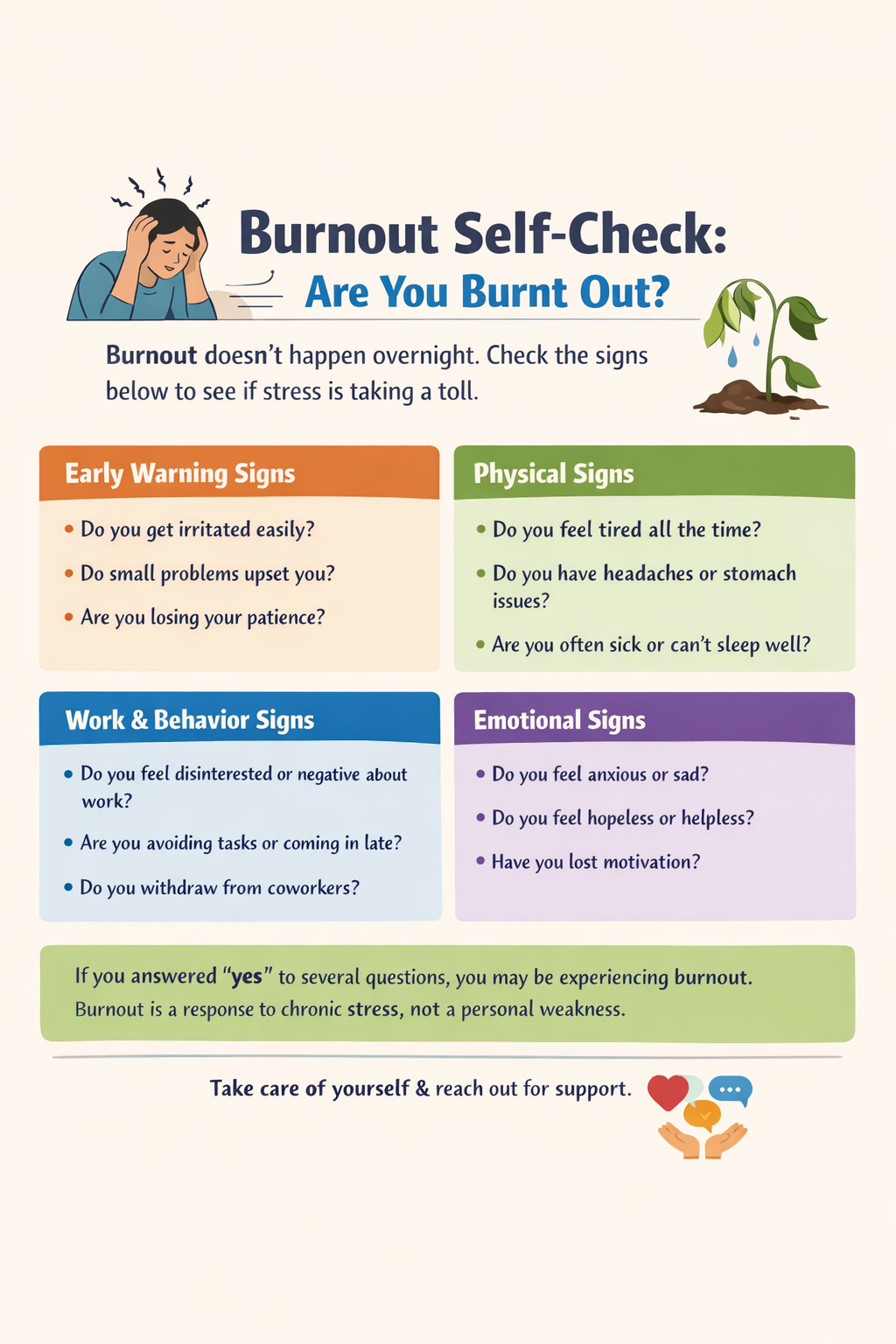
Signs of Burnout
What Does Burnout Feel Like?
Burnout manifests in three core dimensions:
- Feelings of energy depletion or exhaustion
- Increased mental distance from work, including cynicism or negativism
- Reduced professional efficacy
The signs of burnout are often subtle at first, and many people do not associate them with workplace stress. One of the earliest indicators is irritability, frustration, and reduced tolerance [2].
The signs of burnout can be grouped into three categories [1–3]:
- Physical
- Behavioural
- Emotional
Physical Signs of Burnout
- Persistent tension and irritability
- Headaches
- Muscle aches
- Gastrointestinal upset
- Frequent illnesses due to reduced immunity
- Sleep disturbances
- Appetite changes
- Extreme fatigue not relieved by rest
Behavioural and Occupational Signs of Burnout
- Cynicism or depersonalisation
- Withdrawal from responsibilities
- Tardiness
- Social isolation
- Procrastination
- Frustration with others
- Skipping work, arriving late, or leaving early
- Difficulty concentrating
- Reliance on food or alcohol to cope
- Poor memory and ineffective coping with work demands
- Reduced empathy
Emotional Symptoms of Burnout
- Anxiety
- Depressive symptoms
- Helplessness and hopelessness
- Powerlessness
- Low self-esteem
- Dissatisfaction with personal achievements
- Emotional distress
- Sense of failure
- Detachment and loss of motivation
CLICK HERE TO ACCESS THE BURNOUT CHECKLIST
Consequences of Burnout
When burnout is not recognised and properly managed, it can lead to several sequelae, including:
- Reduced job satisfaction
- Suboptimal patient or client care
- Strained or broken relationships
- Increased risk of errors at work
- Increased risk of chronic diseases and mental health disorders
- Suicidal ideation
- Alcohol and drug misuse
How to Prevent Burnout
Although some causes of burnout are beyond individual control, several protective measures can reduce risk:
- Prioritising self-care and recognising when to rest
- Regular physical activity to boost feel-good hormones
- Balanced nutrition
- Healthy sleep routines
- Positive relationships with colleagues and managers
- Finding work that aligns with personal values and purpose
- Strong family and social support systems
- Mindfulness practices
Supportive work environments, adequate staffing, and resilience training also play an important protective role.
How to Recover from Burnout
Recovery from burnout requires both personal and workplace interventions [4,5].
Recognise the Problem
Recovery begins with acknowledging that burnout exists. Awareness is the first step toward healing.
Make Workplace Changes
- Discuss challenges with supervisors and explore less stressful schedules
- Identify tasks that can be reduced or removed
- Delegate or outsource when possible
- Develop predictable work routines
- Seek support from colleagues, family, and friends
Prioritise Self-Care
- Schedule time for relaxation, exercise, and mindfulness
- Improve sleep habits
- Eat nutritious meals
Create Distance
- Take leave from work
Travel or take a restorative vacation
Seek Professional Help
Mental health professionals can support recovery through approaches such as cognitive behavioural therapy and mindfulness. Cognitive behavioural therapy helps identify negative thinking patterns and improve coping strategies.
Effective treatment works best alongside supportive workplace interventions.
Should I Leave my Job Because of Burnout?
You do not automatically need to leave your job because of burnout. In many cases, burnout improves with intentional lifestyle changes and adjustments within the work environment.
However, if burnout persists despite these efforts and your physical or mental health is severely affected, leaving your job may become necessary. In such situations, your health should take priority.
If you decide to step away from your job, it is important to plan carefully. Ensure you have a backup financial plan, as financial strain can sometimes be more stressful than burnout itself. Exploring new employment opportunities or acquiring new skills to transition into a different career path can also make the change less overwhelming and more sustainable.
Leaving a job due to burnout is not a failure. It can be a strategic decision to protect your well-being and create a healthier, more fulfilling future.
WATCH THE EXPLAINER VIDEO HERE
Conclusion
Burnout is a real and growing workplace challenge that affects both health and productivity.
It develops gradually and is often missed until it becomes severe. Early recognition and timely action can prevent serious consequences.
Recovery requires a combination of self-care, workplace adjustments, and support. Protecting your well-being is essential, not optional.
References
- Khammissa RAG, Nemutandani S, Feller G, Lemmer J, Feller L. Burnout phenomenon: neurophysiological factors, clinical features, and aspects of management. J Int Med Res [Internet]. 2022 Sep 13 [cited 2026 Jan 30];50(9):03000605221106428. Available from: https://www.ncbi.nlm.nih.gov/pmc/articles/PMC9478693/
- Karakolias S. Seeing burnout coming: early signs and recognition strategies in health professionals. Front Public Health [Internet]. [cited 2026 Jan 30];13:1721220. Available from: https://www.ncbi.nlm.nih.gov/pmc/articles/PMC12689927/
- Puigtió‐Rebollo N, Serdà‐Ferrer BC, Sitjar Suñer M, Gacto‐Sánchez M. Burnout and Physical Symptoms in Healthcare Professionals: A Cross‐Sectional Study. Nurs Open [Internet]. 2025 Nov 23 [cited 2026 Jan 30];12(11):e70379. Available from: https://www.ncbi.nlm.nih.gov/pmc/articles/PMC12640880/
- Zhang H, Xia Z, Yu S, Shi H, Meng Y, Dator WL. Interventions for Compassion Fatigue, Burnout, and Secondary Traumatic Stress in Nurses: A Systematic Review and Network Meta‐Analysis. Nursing & Health Sciences [Internet]. 2025 Mar [cited 2026 Jan 30];27(1):e70042. Available from: https://onlinelibrary.wiley.com/doi/10.1111/nhs.70042
- McFarland DC, Hlubocky F. Therapeutic Strategies to Tackle Burnout and Emotional Exhaustion in Frontline Medical Staff: Narrative Review. Psychol Res Behav Manag [Internet]. 2021 Sep 15 [cited 2026 Jan 30];14:1429–36. Available from: https://www.ncbi.nlm.nih.gov/pmc/articles/PMC8450185/
Disclaimer:
The information provided on this website is for general educational and informational purposes only. It is not intended to replace professional medical advice, diagnosis, or treatment. Always seek the advice of your physician or other qualified health provider with any questions you may have regarding a medical condition.
Published February 7, 2026