Snake Bite: What to Do Before and At the Hospital – A Quick Patient Education Checklist
Author: Azuka Chinweokwu Ezeike, MBBS, FWACS (Obstetrics and Gynaecology), FMCOG, MSc (Public Health)
Introduction
Snake bites can happen anywhere, especially in rural and farming communities.
Most snake bites are not dangerous, but a bite from a venomous snake can be life-threatening if medical care is delayed.
What happens between the time of the bite and arrival at the hospital is very important.
This checklist explains what to do immediately, what not to do, and what to expect at the hospital.
WATCH YOUTUBE VIDEO ON SNAKE BITE MANAGEMENT HERE
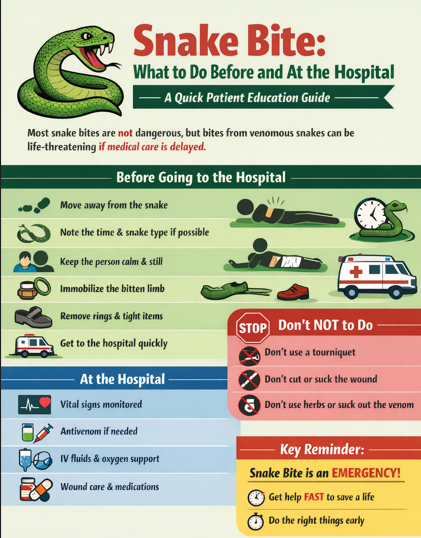
What to Do Before Going to the Hospital
- Move away from the snake
This helps to prevent another bite. - Note the time of the bite
If possible, remember what the snake looked like.
Do not try to catch or kill it. It may lead to a delay in getting to the hospital. - Keep the person calm and still
Panic and movement can cause venom to spread faster. - Immobilise the affected limb
Keep the bitten arm or leg still, at heart level if possible.
Movement increases the speed of venom spread. - Remove tight items
Remove rings, bangles, shoes, or tight clothing near the bite.
Swelling can make them difficult or impossible to remove later. - Avoid walking
If possible, carry the person on a stretcher.
You can improvise using a plank, mat, or cloth. - Apply a firm pressure bandage if trained to do so
This should not be tight enough to stop blood flow to the area.
Do not apply this if you are unsure how. - Give paracetamol for pain if needed
Do not give aspirin or ibuprofen. - Transport immediately to the nearest hospital
If available, call an ambulance immediately. - If vomiting occurs, place the person on their side
This helps prevent choking. - Monitor breathing and consciousness
Be ready to support breathing (resuscitate) if the person becomes weak or unresponsive.
What NOT to Do After a Snake Bite
- Do not apply a tight tourniquet
This can cut off the blood supply and worsen tissue damage. - Do not cut the wound
- Do not suck out the venom
- Do not apply herbs, chemicals, or traditional remedies
- Do not apply ice or electric shocks
- Do not give alcohol or stimulants
These actions do not remove venom and can make the situation worse.
What to Expect at the Hospital
- Snake bite is treated as a medical emergency
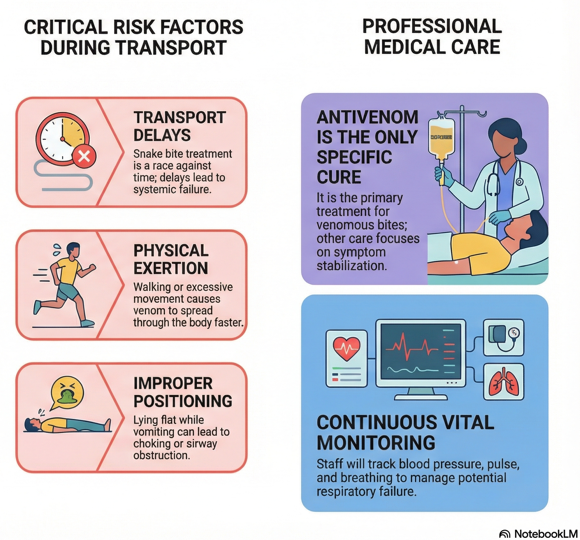
- Health workers will closely monitor vital signs, including:
- Blood pressure
- Pulse rate
- Temperature
- Breathing rate
- Blood pressure
- A drip (IV fluid) may be started to support blood circulation.
- Antivenom may be given if a venomous bite is suspected.
This is the only specific treatment for snake venom. - If antivenom is not available, the patient will be:
- Stabilized
- Treated for symptoms
- Referred urgently to a facility with antivenom
- Stabilized
- Breathing support may be provided if needed.
- The bite wound will be cleaned and treated, and antibiotics or tetanus protection may be given when necessary.
Factors That Increase the Risk of Death from Snake Bite
- Delay in getting to the hospital
- Improper transport, such as:
- Excessive movement
- Walking long distances
- Lying flat on the back while vomiting
- Excessive movement
- Lack of antivenom, especially in some primary health care facilities
- Poor emergency response systems
Key Takeaway
Snake bite is a race against time. Immobilise the victim, avoid harmful practices, and get to the hospital as fast as possible.
Sources
- World Health Organization. Guidelines for the management of snakebites, 2nd edition [Internet]. [cited 2026 Feb 3]. Available from: https://www.who.int/publications/i/item/9789290225300
- World Health Organization (WHO). Control of Neglected Tropical Diseases, Snake bite envenoming treatment [Internet]. [cited 2026 Feb 3]. Available from: https://www.who.int/teams/control-of-neglected-tropical-diseases/snakebite-envenoming/treatment
Disclaimer:
The information provided on this website is for general educational and informational purposes only. It is not intended to replace professional medical advice, diagnosis, or treatment. Always seek the advice of your physician or other qualified health provider with any questions you may have regarding a medical condition.
Published February 4, 2026