PCOS Has Been Renamed Polyendocrine Metabolic Ovarian Syndrome (PMOS)
Author: Azuka Chinweokwu Ezeike, MBBS, FWACS, FMCOG, MSc (PH)
Introduction
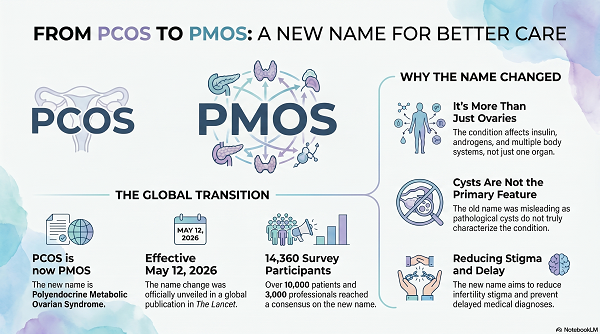
In a historic move, Polycystic Ovarian Syndrome (PCOS) has now been renamed Polyendocrine Metabolic Ovarian Syndrome (PMOS). This was unveiled in a publication released on May 12, 2026.
The publication was authored by Helena J. Teede and colleagues in The Lancet on behalf of the Global Name Change Consortium.
The change follows years of international advocacy by patients, healthcare professionals, researchers, and health organisations who believed the former name did not accurately describe the condition.
What You Need to Know About PCOS
Polycystic Ovarian Syndrome affects up to 170 million women of reproductive age worldwide.Because it is so common, the condition is widely discussed in both medical and non-medical circles.
It is associated with:
- Menstrual irregularities
- Fertility challenges
- Weight gain
- Acne
- Excessive hair growth
- Other cosmetic concerns
Beyond these symptoms, the condition also increases the risk of several non-communicable diseases because of its strong association with insulin resistance and metabolic dysfunction.
Why the PCOS Name Change Became Necessary
For many years, PCOS was mainly viewed as a gynaecological condition affecting the ovaries. However, scientific evidence has shown that the condition goes far beyond the ovaries.The disease is linked to insulin resistance, male hormones called androgens, metabolic abnormalities, and other hormonal imbalances.
In simple terms, it affects several systems in the body, not just one organ.
Experts also pointed out that the old name could be misleading because:
- Pathological ovarian cysts do not truly characterise the condition, as the name suggests.
- The disease affects hormonal, metabolic, reproductive, psychological, and skin health.
- The strong focus on the ovaries may contribute to infertility stigma.
- The old name may create confusion and delay diagnosis.
- The misclassification may affect research data and public health reporting.
Who Led the Global PCOS Name Change Initiative?
The name change was the result of a global consensus involving patients, multidisciplinary healthcare professionals, researchers, and organisations across different countries.
The initiative was led by:
- Verity, a UK PCOS Charity
- Monash University Centre for Research Excellence in Women's Health in Reproductive Life
- Androgen Excess and PCOS Society
Funding support was received from the Australian National Health and Medical Research Council.The process officially started in September 2024 and was completed in 2026.
The Scientific Process Behind the PCOS Name Change
The decision was not made overnight.
The process involved surveys, workshops, expert discussions, and marketing analyses.
Two major surveys conducted in April 2025 and April 2026 received 14,360 responses from 10,411 patients and 3,949 healthcare professionals. This was also built on 7,708 responses from earlier surveys conducted before the formal initiative began.
This broad consultation helped experts understand the concerns surrounding the old name and the need for a more accurate one.
What Happens Next?
A transition roadmap has already been developed to support the adoption of the new name in:
- Clinical care
- Research
- Medical education
- Public communication
The goal is to ensure a smooth transition globally while improving awareness and understanding of the condition.
Conclusion
This name change is more than a change in terminology. It reflects a deeper understanding of a condition that affects millions of women worldwide.
More importantly, it highlights the need for accurate health communication, reduced stigma, earlier diagnosis, and better care for women living with the condition.
Source
Teede H, Khomami M, Morman R et al.Polyendocrine metabolic ovarian syndrome, the new name for polycystic ovary syndrome: a multistep global consensus process.The Lancet, 2026; 0 Available from: https://www.thelancet.com/journals/lancet/article/PIIS0140-6736(26)00717-8/fulltext
Disclaimer:
The information provided on this website is for general educational and informational purposes only. It is not intended to replace professional medical advice, diagnosis, or treatment. Always seek the advice of your physician or other qualified health provider with any questions you may have regarding a medical condition.
Published May 12, 2026