Jehovah’s Witnesses 2026 Update on Blood Transfusion: The Facts
Author: Azuka Chinweokwu Ezeike, MBBS, FWACS, FMCOG, MSc (PH)
On March 20, 2026, in a recent update, the Governing Body of the Jehovah’s Witnesses clarified its position on blood transfusion, particularly regarding the use of one’s own blood for medical procedures.
Who Are the Jehovah’s Witnesses?
The Jehovah’s Witnesses are a global Christian religious organisation present in 241 countries, with a membership of over 9.2 million people.They operate on a set of beliefs derived from the Bible. Some of these beliefs differ from those of other Christian groups due to differing interpretations. One of their most widely known beliefs is their stance on blood transfusions.
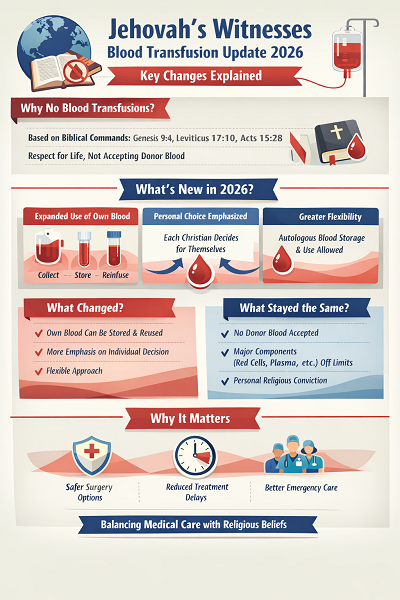
They believe that God is the giver of life and that Christians must respect life. Since blood is viewed as representing life, receiving a blood transfusion is prohibited. This position is based on scriptural references such as Genesis 9:4, Leviticus 17:10, Deuteronomy 12:23, and Acts 15:28.
Because of this, members do not accept blood transfusions, even in life-threatening situations. This has been a longstanding concern within the medical community. The group has also been at the forefront of advocating for non-blood management in medical and surgical care.
Summary of the Update
Their position on the use of one’s own blood (autologous transfusion) is not entirely new. However, this update provides clearer guidance and expands the scope of permitted activities.
In the October 15, 2000 issue of The Watchtower (an official publication of the Jehovah’s Witnesses), it was stated:
A Christian must decide for himself how his own blood will be handled during a surgical procedure, medical test, or current therapy.
This allowed for the use of one’s own blood, provided it was maintained in a continuous circuit. Examples include dialysis, cell salvage, and heart-lung machines.
Key Basis of the 2026 Update
The recent clarification is based on the following:
- It relies on the Apostolic decree in the book of Acts (New Testament), rather than Mosaic Law (Old Testament)
- The Bible does not explicitly address the use of one’s own blood
- It allows room for individual decision-making
What Has Been Expanded?
The current update broadens this position:
Each Christian is expected to decide personally how their own blood will be used in ALL medical and surgical care.
This includes whether to be:
- Removed
- Stored
- Re-infused later
This represents a shift from the earlier restriction where only blood kept in a continuous circuit was acceptable.
What Changed in 2026
The March 2026 update appears to be more of a:
- Clarification and softening of interpretation
- Reduced emphasis on rigid “continuous circuit” rules
- Greater emphasis on individual conscience
This is a subtle but important shift. It is not a brand-new doctrine but a broader, more flexible application of an existing one.
What Has NOT Changed
- Transfusion of whole blood from another person is still not accepted
- Decisions are still framed as personal religious convictions (members may choose based on conscience)
Why This Matters Medically
This update is significant because it:
- Expands options for safer surgical care
- May reduce treatment delays
- Gives clinicians more flexibility in managing severe bleeding and emergencies
Conclusion
The March 2026 update by the Jehovah’s Witnesses is not a complete doctrinal shift, but it is an important clarification with clinical implications. By expanding the scope of how a person’s own blood can be used, the update introduces greater flexibility while still preserving the core belief around allogenic blood transfusion (receiving blood from another person).
For clinicians, this creates more room for collaboration, planning, and safer care delivery. For patients, it reinforces personal responsibility and informed decision-making.
This is where medicine and belief must meet with mutual respect. Understanding these nuances is not optional. It is essential for ethical practice, patient-centred care, and better outcomes.
Source
2026 Governing Body Update. March 20, 2026. Available from: https://www.jw.org/en/news/region/global/2026-Governing-Body-Update-2/
Disclaimer:
The information provided on this website is for general educational and informational purposes only. It is not intended to replace professional medical advice, diagnosis, or treatment. Always seek the advice of your physician or other qualified health provider with any questions you may have regarding a medical condition.
Published March 25, 2025