Fasting and Your Health: Benefits, Risks, and What Science Says

Author: Azuka Chinweokwu Ezeike, MBBS, FWACS, FMCOG, MSc (PH)
Highlights
- Fasting is the voluntary restriction of food for a period of time, often for religious or health-related reasons.
- Fasting triggers a shift from using glucose to using fat for energy, promoting fat burning and supporting weight loss.
- It can improve blood sugar control and enhance insulin function, helping to reduce the risk of diabetes.
- Fasting may support heart health by lowering blood pressure and reducing levels of bad cholesterol.
- It may also improve mental clarity, mood, and overall brain function.
- Despite these benefits, fasting is not suitable for everyone.
Introduction
The body is accustomed to being fed, so skipping meals is never convenient. Most of the time, fasting is associated with religion in anticipation of spiritual benefits. It may be done on the instructions of a health practitioner as part of the investigations or a medical procedure. But apart from these reasons, people also fast for the presumed health benefits. Is this inconvenience necessary? Does fasting have any health benefits?
Fasting is any practice that involves restricting food or drink for a brief period [1]. If the body has been programmed to run on nutrients, is there any benefit to withholding meals?This article provides science-based information on how fasting affects your body and the health benefits of fasting.
Types of Fasting
There are different types of fasting based on purpose, dietary variation and schedule [2].
Based on Duration
Short-term Fasting
Defined as fasting that lasts for 2–3 days.
Prolonged Fasting
Fasting that lasts for 4 or more consecutive days..
Based on Dietary Variation
General Fasting
The voluntary abstinence from some or all foods, or both foods and beverages. Some also refer to it as ‘dry’ fasting.
Modified Fasting
A regimen where energy intake is restricted to a maximum of 25% of an individual's energy needs (25% of the food intake for the day is consumed).
Fluid-only Fasting
A term for fasting that excludes solid foods but allows fluids.
According to the Schedule
Intermittent fasting
A form of fasting focused on limiting food consumption to a specific window of time during the day.
Alternate-day Fasting
A regimen involving alternating between days of eating and days of fasting
Based on Purpose
- Religious Fasting
Practised by religious adherents to strengthen virtues or express devotion eg Lenten fast, Ramadan fast.
Therapeutic or Medically Supervised Fasting
Longer fasting regimens medically recommended as a treatment strategy for chronic, inflammatory, or metabolic diseases.
Fasting as part of the preparation for a lab test or surgical procedure
What Happens to Your Body During Fasting?
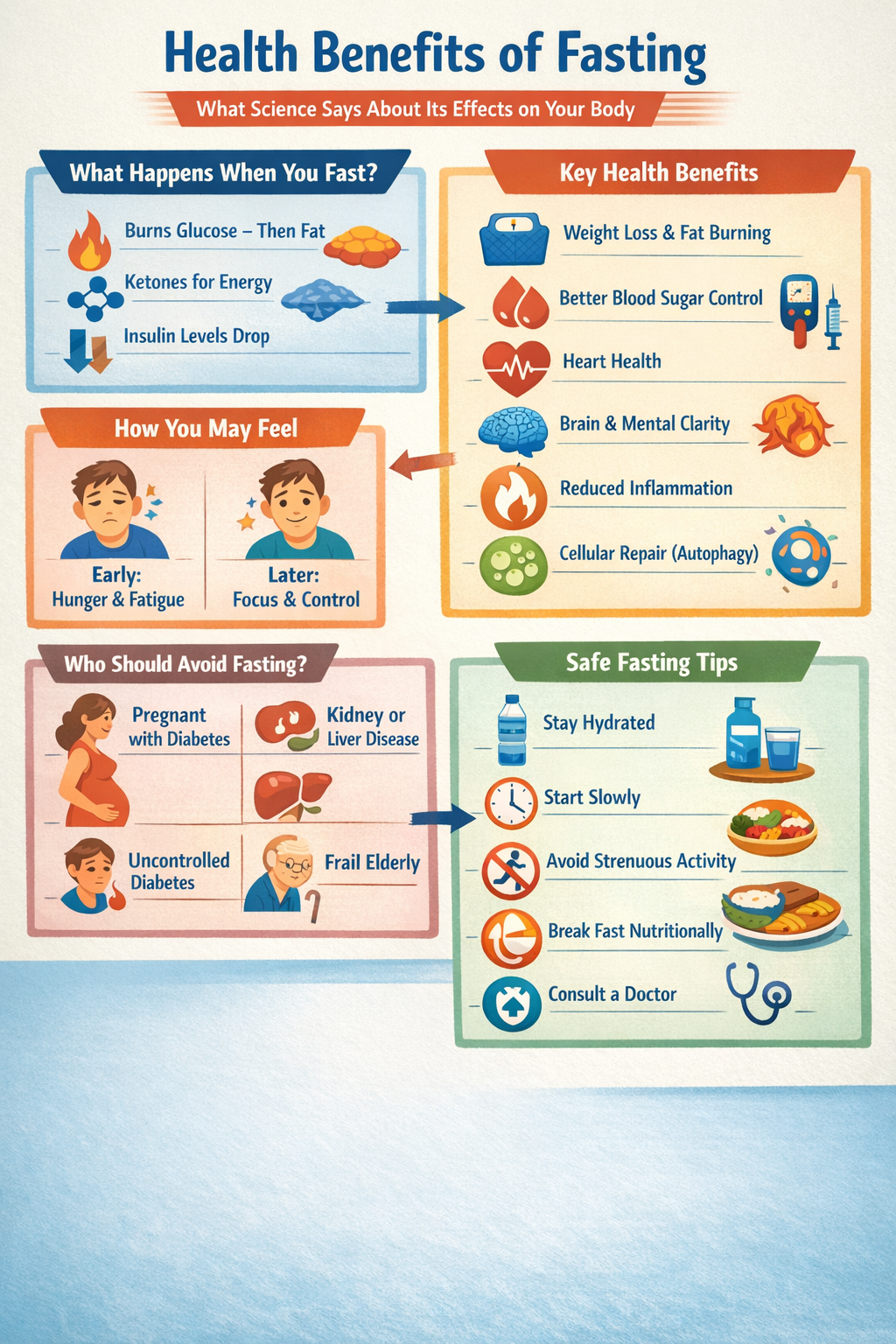
While there are many ways to fast, science shows that these patterns lead to several important changes in how your body functions [3].
Effects on Fat and Sugar
Your body uses glucose (sugar) from your last meal for energy. When you fast, your body goes through a "metabolic switch" to maintain energy. The effects include:
Fat Burning
After about 12 to 36 hours of fasting, your body uses up its stored sugar and begins breaking down body fat for fuel. This process can lower "bad" Low Density Lipoprotein (LDL) cholesterol and triglycerides. This supports heart health.
Ketone Production
As fat breaks down, your liver produces some chemicals called ketones. These serve as a powerful alternative energy source for your body and especially your brain.
Blood Sugar and Insulin
Fasting can help lower blood sugar levels and improve how your body responds to insulin (the hormone that regulates blood sugar levels). This is particularly helpful for people with obesity or prediabetes.
Effects on the Brain and Mood
The relationship between fasting and your mental state is complex and can vary from person to person:
Mixed Emotions
Some people experience negative feelings like irritability, anxiety, or fatigue when they start fasting. However, others report "mood enhancement," feeling a sense of achievement, pride, and improved vitality.
Brain Health
Fasting may stimulate "neuroplasticity," which is your brain's ability to adapt and repair itself. It may also increase the release of serotonin and endorphins, the body's natural "feel-good" chemicals.
Self-Control
Successfully sticking to a fasting routine can boost your sense of self-control and reward.
Changes to Hormones and Proteins
Fasting acts as a mild stressor that triggers the release of various hormones.
Energy Hormones
During a fast, your body releases hormones such as growth hormone and glucagon while decreasing thyroid hormone levels.
Protein Use
When you aren't eating, your body may break down some proteins and amino acids to maintain sufficient energy.
WATCH THE YOUTUBE SHORTS VERSION OF THE ARTICLE HERE
Health Benefits of Fasting
Clinical and metabolic reasearch has shown that fasting is associated with a wide range of health benefits, ranging from basic weight management to the potential prevention and treatment of chronic diseases [4].
The following are the key health benefits of fasting:
Longevity and Ageing
- Increased Lifespan: Fasting has been shown to extend the life-spans of both animals and humans.
- Slower Ageing: It can slow the biological ageing process and delay the onset of diseases typically associated with ageing.
- Cellular Repair (Autophagy): Fasting triggers "autophagy," a process in which your body clears out old or damaged proteins and cellular components, which is vital for regeneration and maintaining a healthy balance.
Weight Loss and Metabolic Health
- Weight Management: Fasting is an effective tool for losing weight and reducing body fat.
- Blood Sugar Control: It improves how the body handles sugar by increasing insulin sensitivity and lowering fasting insulin levels, thereby reducing the risk of type 2 diabetes.
- Metabolic Switch: When the body runs out of stored sugar, it switches to burning fat and producing ketones, which provide an alternative energy source for the brain and heart.
Heart Health
- Lower Blood Pressure: Fasting reduces blood pressure.
- Improved Cholesterol: It can help lower "bad" (LDL) cholesterol and triglyceride levels.
- Reduced Disease Risk: Routine fasting is associated with a lower risk of coronary artery (heart blood vessel) disease and other cardiovascular issues.
Brain and Mental Health
- Neuroprotection: Fasting may protect the brain from damage and slow the progression of diseases like Alzheimer's and Parkinson's.
- Improved Memory: It has been shown to improve memory and delay cognitive decline.
- Mental Clarity: Some people experience a "clarity of mind" and a more positive attitude after short-term fasting.
Immune System and Cancer
- Improved Immunity: Fasting can strengthen the immune system and improve the body’s ability to fight off infections.
- Cancer Treatment: In cancer patients, fasting may slow tumour growth and make chemotherapy treatments more effective by making cancer cells more vulnerable.
Inflammation and Gut Health
- Reduced Inflammation: Fasting helps suppress chronic inflammation, which is a root cause of many diseases.
- Healthy Gut: It positively influences the gut microbiome (the healthy bacteria in your digestive system), which plays a major role in overall metabolism and immunity.
- Relief for Chronic Conditions: Fasting therapies have been used to treat various inflammatory and painful conditions, such as rheumatoid arthritis, asthma, and irritable bowel syndrome (IBS).
Possible Risks of Fasting
Though fasting is generally safe, sometimes it may be associated with side effects.
They include:
- Lethargy: Feeling very tired or having low energy
- Headaches: These are often mild to moderate and are frequently caused by low blood sugar (hypoglycemia).
- Mood Swings: Many people experience mood changes while fasting.
- Dizziness: Feeling lightheaded or unsteady is a common experience.
- Confusion or difficulty concentrating: Because your brain relies heavily on glucose to function, very low blood sugar can sometimes lead to
Other potential side effects include:
- Digestive Issues: These can include constipation,abdominal pain, bloating, nausea, and occasionally vomiting.
- Dehydration: A lack of sufficient fluids in the body.
- Heart Palpitations: The sensation of the heart racing or fluttering.
- Sleep Problems: Some individuals may experience insomnia or trouble sleeping.
- Physical Weakness: General feelings of weakness or lack of strength.
- Flu-like Symptoms: Some people may start feeling feverish or having symptoms similar to a cold or the flu
Who Should Not Fast
Fasting is not suitable for everyone. If you have any of these diseases, it is better to avoid fasting, especially prolonged fasting periods [5,6]. Visiting your doctor for a proper review before any fasting program is necessary.
- Severe Kidney Disease: Patients with Chronic kidney disease stage 4 or 5 or those on chronic dialysis.
- Recent Severe Blood Sugar Issues: Anyone who has experienced a severe low blood sugar event (hypoglycemia) or a dangerous high blood sugar emergency (like ketoacidosis) .
- Poorly Controlled Type 1 Diabetes: Individuals with unstable Type 1 diabetes.
- Acute Illness: Anyone currently suffering from a temporary, serious illness.
- Pregnancy: Pregnant women, especially those with pre-existing diabetes or gestational diabetes that requires treatment.
- Frailty: Elderly persons.
- Advanced Heart Disease: Patients with significant macrovascular complications (heart or blood vessel disease)
- People on medications that require food intake
- Those with peptic ulcer disease
- Severe liver disease
Practical Tips fro Safe Fasting
While you are fasting, your body is in a "clean-up" and repair mode [7]. You need to support it with these habits:
- Stay Hydrated: Drink at least 3 litres of water every 24 hours. This supports your immune and circulatory systems while removing waste from your body.
- Rest: Avoid strenuous or heavy physical activity. Focus on rest and light movement, such as yoga or soft gymnastics.
- Maintain Temperature: Avoid extreme heat (like saunas) or extreme cold, as these can stress your heart and affect your blood pressure.
- Limit spicy food
- No Smoking: Avoid smoking during a fast. Food deprivation can change smoking behaviour, and the toxins in cigarettes can cancel out the anti-inflammatory benefits of the fast.
- Re-introduce food using a healthy diet.
When Should You See a Doctor?
If you experience severe weakness or dizziness during a fast or worsening of a chronic medical condition, stop the fast and see your doctor.
Conclusion
Fasting is more than a religious or cultural practice. It triggers important body processes that can support weight management and overall health. While fasting offers many potential benefits, it is not a "one-size-fits-all" solution. The effects can depend on your age, weight, and overall health.A thoughtful, well-informed approach is essential. If in doubt, especially for prolonged fasting, it is always wise to seek medical guidance before starting
WATCH THE FULL EXPLAINER VIDEO HERE
Frequently Asked Questions (FAQs)
How can beginners start fasting safely?
Beginners can start with shorter fasting periods, drink enough water, and gradually increase the fasting duration.
Can fasting help the body remove toxins?
Fasting may support natural body processes that repair cells and remove waste products.
How long should a person fast to get health benefits?
There isn’t a single “perfect” fasting duration for everyone. The health benefits depend on the person, their goals, and their overall health.
References
- Sanvictores T, Casale J, Huecker MR. Physiology, Fasting. In: StatPearls [Internet]. Treasure Island (FL): StatPearls Publishing; 2025 [cited 2026 Mar 4]. Available from: http://www.ncbi.nlm.nih.gov/books/NBK534877/ PubMed PMID: 30521298.
- Koppold DA, Breinlinger C, Hanslian E, Kessler C, Cramer H, Khokhar AR, et al. International consensus on fasting terminology. Cell Metab. 2024 Aug 6;36(8):1779-1794.e4. doi:10.1016/j.cmet.2024.06.013 PubMed PMID: 39059384; PubMed Central PMCID:PMC11504329. Available from: https://www.sciencedirect.com/science/article/pii/S1550413124002699
- Wang Y, Wu R. The Effect of Fasting on Human Metabolism and Psychological Health. Dis Markers. 2022 Jan 5;2022:5653739. doi:10.1155/2022/5653739 PubMed PMID: 35035610; PubMed Central PMCID: PMC8754590. Available from:https://pubmed.ncbi.nlm.nih.gov/35035610/
- Mackieh R, Al-Bakkar N, Kfoury M, Okdeh N, Pietra H, Roufayel R, et al. Unlocking the Benefits of Fasting: A Review of its Impact on Various Biological Systems and Human Health. Curr Med Chem. 2024;31(14):1781–803. doi:10.2174/0109298673275492231121062033 PubMed PMID: 38018193. Available from: https://pubmed.ncbi.nlm.nih.gov/38018193/
- Ahmad S, Chowdhury TA. Fasting during Ramadan in people with chronic kidney disease: a review of the literature. Therapeutic Advances in Endocrinology and Metabolism. 2019 Nov 14;10:2042018819889019. doi:10.1177/2042018819889019 PubMed PMID: 31798822. Available from: https://pmc.ncbi.nlm.nih.gov/articles/PMC6859673/
- Bhuiyan MN, Saadiq RA, Mueller MR, Abdalrhim AD, Overgaard J. Patient Care During Ramadan: A Narrative Review. Health Serv Res Manag Epidemiol. 2024 Jul 21;11:23333928241266041. doi:10.1177/23333928241266041 PubMed PMID: 39050928; PubMed Central PMCID: PMC11268016. Available from: https://pubmed.ncbi.nlm.nih.gov/39050928/
- Attinà A, Leggeri C, Paroni R, Pivari F, Dei Cas M, Mingione A, et al. Fasting: How to Guide. Nutrients. 2021 May 7;13(5):1570. doi:10.3390/nu13051570 PubMed PMID: 34067055; PubMed Central PMCID: PMC8151159. Available from: https://pubmed.ncbi.nlm.nih.gov/34067055/
Disclaimer:
The information provided on this website is for general educational and informational purposes only. It is not intended to replace professional medical advice, diagnosis, or treatment. Always seek the advice of your physician or other qualified health provider with any questions you may have regarding a medical condition
Published March 17,2026