Alzheimer’s Disease: What You Need to Know

Author: Zoobia Nadeem, MBBS
Medical Reviewer: Nnenna Chiloli, MBBS, MPH
Highlights
- Alzheimer’s disease is the most common cause of dementia.
- It leads to progressive loss of memory and thinking ability.
- It is linked to amyloid plaques and tau tangles in the brain.
- Risk factors include age, hypertension, inactivity, and hearing loss.
- Early-stage drugs like lecanemab may slow disease progression.
- Diagnosis is based on clinical evaluation, imaging, and biomarkers.
- Care often requires long-term support and caregiver involvement.
What Is Alzheimer's Disease (AD)?
You may forget your name or misplace your keys from time to time. That is normal. But what happens when remembering becomes a daily challenge? What occurs when you are no longer able to identify your own family? It is quite a different story and the reality of living with Alzheimer's disease for millions of people.
AD is a progressive disorder of the brain. It gradually impairs your memory, thinking, and even your capability to perform simple tasks. It is the prevalent cause of dementia and accounts for 60 to 80 percent of all cases of dementia in the world [1].
If you or someone close to you is over the age of 65, the risk becomes more relevant. In the year 2025, an estimated 7.2 million Americans aged 65 years or older are living with Alzheimer's disease. Unless medical breakthroughs alter the course of the disease, that number may increase to 13.8 million by 2060 [1].
It is neither an old-age disease nor a memory problem. Rather, it is a complicated and debilitating health condition that can change your life, your relationships, and your daily routine. Understanding it is the first step you can take to respond effectively and support yourself or someone you care about.
What Causes Alzheimer's Disease?
Alzheimer's does not have one single, clear-cut cause. Two major biological changes that can occur in your brain with time have been discovered.
- The initial one is the accumulation of amyloid plaques. They are sticky masses of protein fragments that develop between your nerve cells and disrupt communications between them.
- The second one is tau tangles. Tau is a protein that usually helps maintain the structure of your nerve cells. It is distorted into abnormal tangles in cells in Alzheimer’s, resulting in cell destruction and death.
Your brain shrinks as additional brain cells perish. Memory is affected first in certain areas, which is why your memory loss is frequently the first sign. Research has also found that brain changes associated with Alzheimer’s can disrupt your sleep-wake cycle, slowing deep slow-wave sleep and increasing wakefulness [2].
There appears to be a bidirectional relationship between sleep and Alzheimer’s disease. Poor sleep may increase your risk of developing Alzheimer’s disease. At the same time, Alzheimer’s disease can worsen sleep disturbances. Therefore, maintaining good sleep health is important for your brain health throughout life.Additional factors include:
- Long-term brain inflammation
- Decreased blood flow in your brain
- Metabolic dysfunction, and
- Age-related vessel damage
Who Is at Risk of Alzheimer's Disease?
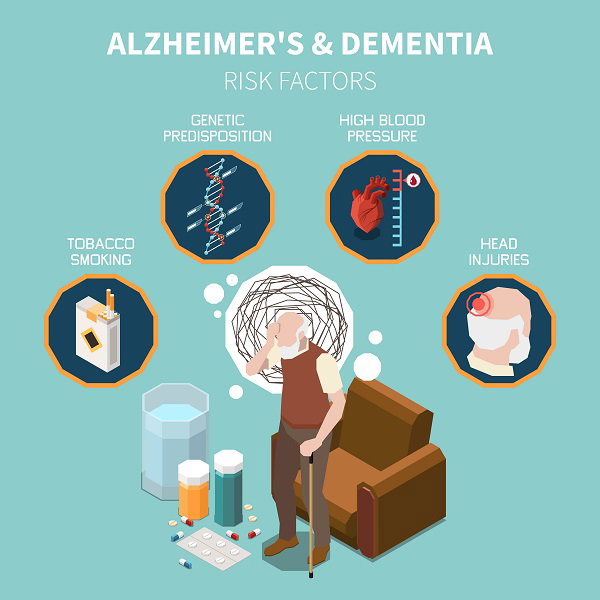
Some risk factors can be changed. Others cannot.
Risk factors that cannot be changed (non-modifiable) include:
Age: Risk doubles roughly every five years after you become 65. About 33.4% of people aged 85 and older have Alzheimer's dementia [1].
Genetics: If you have a parent or sibling with Alzheimer's, it raises your risk of getting the disease. Genetics also plays a role, especially the gene APOE-e4. Carrying a single copy of this gene predisposes risk; two copies increase risk much more. But not everyone who has the disease carries the gene [3].
Gender: The chances of the disease are higher if you’re a woman. Almost two-thirds of Americans with Alzheimer's are women. This gap is partly linked to women living longer on average, though hormonal and biological factors are also being studied.
Risk factors that can be changed (modifiable) include:
- High blood pressure and heart disease
- Type 2 diabetes
- Obesity
- Physical inactivity
- Heavy alcohol use
- Smoking
- Chronic social isolation
- Hearing loss left untreated
- Depression
The good news is that you can prevent it with healthier lifestyle changes. A large 2024 study of nearly 92,000 people found that modifiable risk factors contribute significantly to Alzheimer’s cases across different populations. Older Black Americans are about twice as likely to develop Alzheimer's or other dementias compared to older White Americans, and older Hispanic Americans are about one and a half times as likely [4]. Researchers explain this by both the increased burden of modifiable risk factors within these communities and long-standing inequalities in healthcare and living conditions[4].
Early Signs and Symptoms of Alzheimer's Disease
The early signs are easy to dismiss. You may think that you are stressed, old, or that you have had a bad day.Early warning signs you should look out for are:
- Repeatedly asking the same question or retelling the same story
- Forgetting recently learned information, especially dates or events
- Difficulty handling your finances, bills, or following recipes
- Confusion about dates, seasons, or the passage of time
- Getting lost in familiar locations
- Difficulty finding the right word in conversation
- Poor judgment or decision-making, especially around money or safety
It is worth distinguishing normal ageing from early Alzheimer's. Occasionally forgetting where you left your glasses is normal, but forgetting what glasses are for is not.
How Alzheimer's Disease Progresses
Alzheimer's is not a disease of sudden onset. It occurs gradually, over a long period, in separate phases. If you are diagnosed, the condition can affect you for several years. On average, people live 3 to 11 years after diagnosis, though some can survive for 20 years or more [1].The disease has generally five stages, namely:
- Preclinical Alzheimer's disease
- Mild cognitive impairment (MCI)
- Mild dementia
- Moderate dementia
- Severe dementia.
In the moderate stage, you may no longer recognise your close family members. You may suffer behavioural changes, including agitation, wandering, and sleep disturbances. By the severe stage, round-the-clock care for you becomes necessary.Pneumonia is a common cause of death in late-stage Alzheimer's, often because impaired swallowing allows food or liquid to enter the lungs. Other common causes include:
- Dehydration
- Malnutrition
- Falls
- Infections
How Alzheimer's Disease Is Diagnosed
There is no single test that definitively diagnoses Alzheimer's. A history and physical examination is conducted by your doctors. They’ll ask you about:
- Past strokes
- Parkinson's disease
- Depression
- Sleep apnea
They also ask you to complete tasks. For example, measure memory, abstract thinking, problem-solving, and language skills.
Common diagnostic tools include:
- Cognitive testing for memory and thinking tests
- Blood tests to exclude other causes, e.g., thyroid issues or vitamin deficiencies.
- Brain imaging, such as magnetic resonance imaging (MRI), computed tomography (CT) scans, and positron emission tomography (PET) scans, is used to evaluate your brain structure and amyloid accumulation
- Biomarker testing to measure levels of amyloid and tau proteins in your cerebrospinal fluid or blood
Blood-based biomarker tests have also been found to indicate increased risk of Alzheimer's disease. These can support diagnosis, typically after symptoms appear [5]. Genetic testing is available if you’re at high risk of early-onset Alzheimer's, but it is not recommended for everyone.
Treatment and Management of Alzheimer's Disease
Alzheimer's disease has no cure at the moment. But the following medicines can help manage symptoms.
Medications
Cholinesterase inhibitors
This class includes donepezil, rivastigmine, and galantamine. These drugs work by increasing the levels of acetylcholine, a neurotransmitter involved in memory and learning. They may help temporarily improve or stabilise your symptoms in mild to moderate stages of the disease.Memantine (NMDA receptor antagonist)
Memantine is another neurotransmitter that works by regulating glutamate activity. This neurotransmitter is involved in learning and memory. It is typically used in moderate-to-severe Alzheimer’s disease and may help improve cognition and daily functioning.
Newer Disease-Modifying Treatments
An emerging and promising type of medication attacks the biology of Alzheimer's. The FDA has approved lecanemab and donanemab for people with mild Alzheimer's disease and mild cognitive impairment [6, 7]. Research found that both medications slowed declines in your thinking and functioning with early-stage Alzheimer's.Donanemab received FDA approval on July 2, 2024, for adults with early symptomatic Alzheimer's, including those with mild cognitive impairment and mild dementia with confirmed amyloid plaques[6].
Non-Drug Approaches
Alongside medications, several non-drug strategies can improve your quality of life:
- Planned day-to-day activities to minimise your confusion.
- Exercise promotes the health of your brain and heart.
- Occupational therapy helps you maintain a longer and more independent life.
- Music, art, and recollection therapy
- Caregiver support programs and training.
- Managing sleep, nutrition, and social engagement
Living With Alzheimer's Disease
When you’re diagnosed with Alzheimer's, everything becomes different, but it does not mean that you have to stop living meaningfully. Many people with early-stage Alzheimer's continue to work, travel, socialise, and enjoy life for years after diagnosis.Practical steps that can help you stay independent include:
- Setting up your phone reminders and written calendars
- Arranging your house to minimise risk and confusion.
- Technology like GPS trackers and medication dispensers.
- Staying physically active and socially connected
- Joining local or online Alzheimer's support groups
- Planning for future care while still able to participate in those decisions
It is as important for you to be emotionally healthy as it is to be physically healthy at this stage. People with Alzheimer's experience depression and anxiety. Addressing these through therapy, medication, and social support can significantly improve your day-to-day well-being.
Advance Care Planning
One of the most important steps you can take after an early-stage Alzheimer’s diagnosis is to put an advance care plan in place while you are still able to fully participate in those decisions. This includes:
- Durable power of attorney for finances: Designating a trusted person to manage financial affairs
- Healthcare proxy / durable power of attorney for healthcare: Naming someone to make medical decisions if you become unable to do so
- Advance directive/living will: Documenting wishes regarding life-sustaining treatment and end-of-life care
- POLST / MOLST form: A physician’s order that travels with the patient and guides emergency responders and care facilities
Organisations such as The Alzheimer’s Association in the United States and similar groups worldwide offer free legal consultations and financial planning resources to help families navigate this process. Early planning significantly reduces stress on families and ensures that your wishes are respected throughout the course of the disease.
How to Support Someone With Alzheimer's Disease
Being a caregiver to an individual with Alzheimer's is among the most challenging and emotionally intricate jobs that one may undertake. It asks for patience, flexibility, and a deep reservoir of compassion [1].
Practical tips for caregivers:
- Talk in a low-pitched, clear voice with short sentences.
- Ask simple yes/no questions instead of open-ended ones
- Never argue with or try to correct the person about their confusion
- Make a safe environment. Remove trip hazards, lock away dangerous objects.
- Develop regular daily schedules
- Use familiar music, photos, and objects to comfort and orient
- Be tolerant of repetition. The individual is not acting hard.
When to See a Doctor
Most individuals put off visiting the doctor due to the fear of diagnosis. That fear is understandable. But early diagnosis is genuinely helpful. It rules out treatable causes of memory problems and provides access to treatments that work best in the early stages.See a doctor promptly if you or someone close to you notices:
- Recurring memory loss that interferes with daily life.
- Disorientation to time, place, or familiar people.
- Sudden difficulty with tasks that used to be routine
- Mood or unexplained personality changes.
- Losing track in a well-known environment.
- Difficulty after conversations or word-finding.
Globally, Alzheimer’s disease and related dementia place a heavy financial burden on health systems and families. For example, in the United States alone, total payments in 2025 for health care, long-term care, and hospice for people aged 65 and older with dementia are estimated to reach $384 billion [1]. Early diagnosis can assist families with financial and emotional planning and can lessen the overall burden on the health system in the long term.
Conclusion
One of the most significant medical problems of our age is Alzheimer’s disease. It steals not only your memories and identities but also your relations to the world they have created. But it is possible to understand the disease, notice the symptoms early on, and provide the right treatment and reassurance.
References
- Alzheimer’s Association. 2025 Alzheimer’s disease facts and figures. Alzheimer's Dement. 2025. Available from: https://pmc.ncbi.nlm.nih.gov/articles/PMC12040760/
- Lucey BP, McCullough A, Landsness EC, Toedebusch CD, McLeland JS, Zaza AM, et al. Reduced non–rapid eye movement sleep is associated with tau pathology in early Alzheimer’s disease. Sci Transl Med. 2019;11(474):eaau6550. Available from: https://pubmed.ncbi.nlm.nih.gov/30626715/
- National Institute on Aging. Alzheimer’s disease genetics fact sheet. U.S. Department of Health and Human Services; 2023. Available from: https://www.nia.nih.gov/health/alzheimers-causes-and-risk-factors/alzheimers-disease-genetics-fact-sheet
- Park SY, Setiawan VW, Crimmins EM, White LR, Wu AH, Cheng I, et al. Racial and ethnic differences in the population-attributable fractions of Alzheimer’s disease and related dementias. Neurology. 2024;102(3):e208116. Available from: https://pubmed.ncbi.nlm.nih.gov/38232335/
- Jack CR Jr, Andrews JS, Beach TG, Buracchio T, Dunn B, Graf A, et al. Revised criteria for diagnosis and staging of Alzheimer’s disease: Alzheimer’s Association workgroup. Alzheimer's Dement. 2024;20(8):5143–5169. doi:10.1002/alz. 13859 Available from: https://pubmed.ncbi.nlm.nih.gov/38934362/
- U.S. Food and Drug Administration. FDA approves treatment for adults with Alzheimer’s disease (Kisunla/donanemab). 2024 Jul 2. Available from: https://www.fda.gov/drugs/news-events-human-drugs/fda-approves-treatment-adults-alzheimers-disease
- National Institute on Aging. 2025 NIH Alzheimer’s disease and related dementias research progress report. U.S. Department of Health and Human Services; 2025. Available from: https://www.nia.nih.gov/about/2025-nih-dementia-research-progress-report
Disclaimer:
The information provided on this website is for general educational and informational purposes only. It is not intended to replace professional medical advice, diagnosis, or treatment. Always seek the advice of your physician or other qualified health provider with any questions you may have regarding a medical condition.
Published April 28, 2026