10 Long-Term Risks of Alcohol Use

Medical Writer: Zoobia Nadeem, MBBS
Medical Reviewer: Azuka Chinweokwu Ezeike, MBBS, FWACS, FMCOG, MSc (PH)
Highlights
- Long-term alcohol use silently damages nearly every major organ, often before symptoms appear.
- Heavy drinking increases the risk of liver disease, heart disease, stroke, and multiple cancers.
- Alcohol harms brain function, leading to memory loss, cognitive decline, and mental health disorders.
- Chronic use weakens the immune system, digestive tract, bones, and hormonal balance.
- Alcohol use disorder (AUD) is a treatable medical condition, but it can severely affect relationships, work, and overall health.
- Recognising early warning signs of problematic drinking can help prevent irreversible complications.
Introduction
You may have heard that excessive alcohol consumption is not very healthy. But what is the real meaning of “too much” in the long run, and what is actually going on within your own body when alcohol has become a daily routine?
The fact is, alcohol influences almost all organ systems of the body. In most cases, the effect that alcohol exerts on the organs of the body is slow, and this happens well before clinical symptoms are manifested. This is the true challenge of long-term alcohol abuse [1,2].
This article isn't about judgment. Millions of people drink, and many struggle to cut back even when they want to. The purpose of this article is to make the facts clear, to enable you to make the best decisions regarding yourself.
What Counts as Alcohol Use
The first step to understanding drinking is to know what a standard drink is.
Standard Drink
A standard drink is just a gauge that helps you understand the amount of alcohol you are actually consuming, regardless of the glass size.
In the United States, one standard drink contains about 14 grams, or about 0.6 fluid ounces, of pure alcohol [2]. That is the amount of alcohol in:
- A 12-ounce can of regular beer at 5% alcohol by volume
- A 5-ounce glass of wine at 12% alcohol by volume
- A 1.5-ounce shot glass of distilled spirits at 40% alcohol by volume
Moderate Drinking
Moderate drinking is one drink a day in the case of women and two drinks a day in the case of men. Also worth mentioning is that moderate does not imply an average of drinks per week but rather the number of drinks per day. Drinking nothing all week and having seven drinks on Saturday, for example, is not considered moderate drinking.
Heavy Drinking
Heavy drinking means more than 4 drinks on any single day or more than 14 drinks per week for men, and more than 3 drinks per day or 7 per week for women. A huge percentage of individuals in this group are well employed, have relationships, and do not consider themselves to have a drinking issue, which is precisely why these figures are important. The body experiences the health risks regardless of how "in control" things may feel day to day.
Binge Drinking
Binge drinking means consuming enough in about two hours to bring your blood alcohol level to 0.08% or higher, typically around 4–5 drinks.Long-term health risks tend to rise as drinking moves from moderate toward heavy or binge patterns. But even regular moderate drinking carries some risk for certain conditions [2].
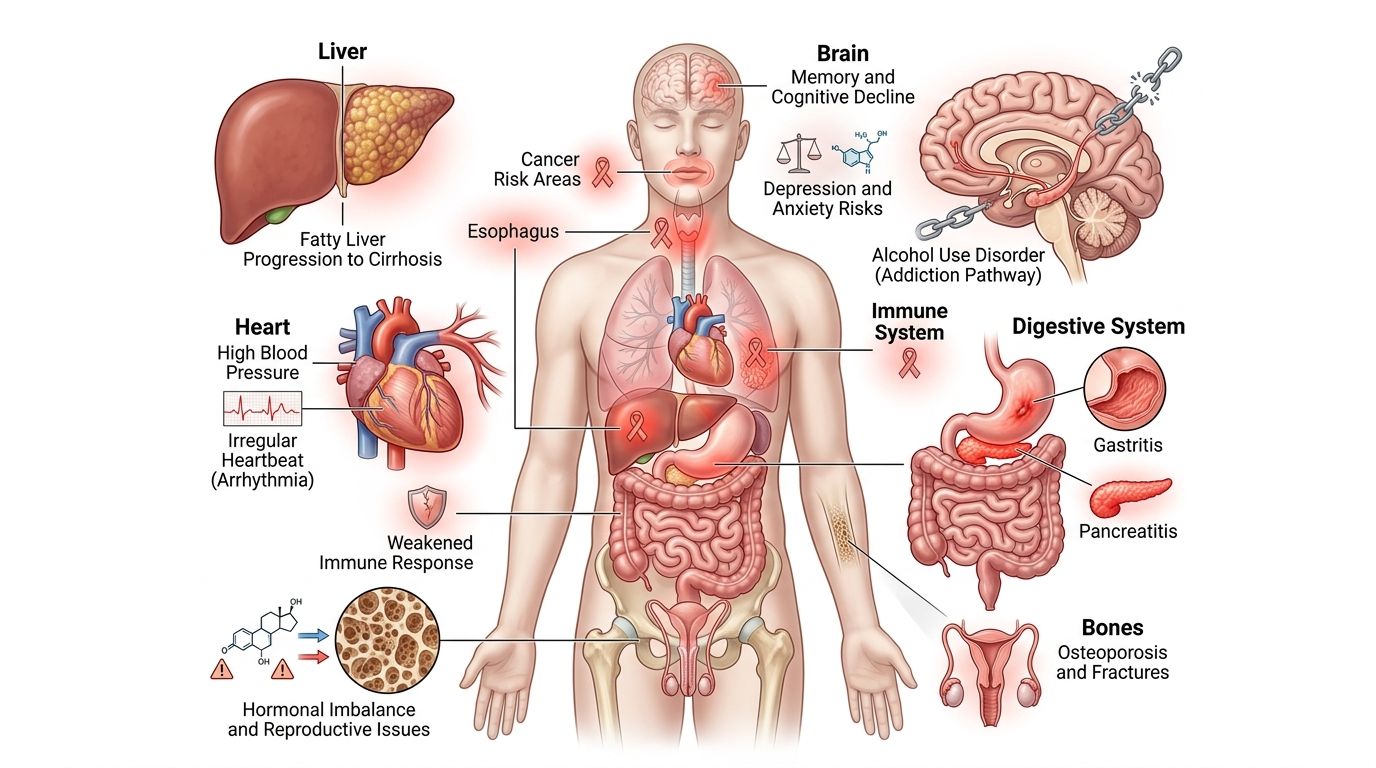
10 Long-Term Health Risks of Alcohol
1. Liver Disease
The liver is the organ most affected by alcohol use. It helps in the decomposition of alcohol in the body. With time, heavy drinking may result in deposition of fat in the liver, resulting in fatty liver disease.
When drinking is persistent, it may lead to alcoholic hepatitis, after which it may degenerate into cirrhosis, where scar tissue replaces the healthy liver tissue. Cirrhosis is severe and, to a large extent, irreversible. The liver is unable to filter toxins effectively, and this has a ripple effect throughout the body [1,2].
2. Heart Disease
There is a complex association between alcohol and the heart. Although there are studies where light drinking was suggested to possess a small protective effect, heavy or prolonged drinking does not say the same thing. It can:
- Increase blood pressure
- Weakening the heart muscle (a disorder referred to as cardiomyopathy), and
- Abnormal heartbeat (atrial fibrillation).
Such changes in the long term predispose to heart failure and stroke. One of the most significant factors that you can do to protect your heart in the long run is to keep alcohol consumption to a minimum [3].
3. Cancer
Alcohol is a Group 1 carcinogen, which means that it is a known cancer-causing substance in human beings. The chronic use of alcohol predisposes you to cancer of the:
- Mouth
- Throat
- Oesophagus
- Liver
- Colon
- Rectum
- Breast
The danger increases with the quantity and duration of drinking. Alcohol seems to:
- Destroy Deoxyribonucleic Acid (DNA)
- Disrupts the body's mechanism in absorbing some nutrients, and
- Raise the levels of estrogen, which can lead to cancer.
Reducing alcohol intake is among the most effective methods of reducing the risk of cancer [4].
4. Brain and Nervous System Damage
Alcohol is a neurotoxin, which implies that it may cause direct harm to brain cells. Constant excessive alcohol consumption can shrink and weaken the brain, areas of memory, decision-making, and emotional control. It also interferes with the chemical balance on which the brain depends to operate.
Prolonged alcoholism is associated with memory loss, mental impairment, and a severe syndrome known as the Wernicke-Korsakoff syndrome - a type of brain damage due to the lack of thiamine (vitamin B1), which may be induced by alcohol use. A few of these effects can be improved with sobriety, but others are possibly permanent [5].
5. Mental Health Disorders
There is a complex two-way relationship between alcohol and mental health:
- The majority of heavy-drinking people are doing it to calm down, to dull the heaviness of a depressive mood, or simply to relieve the tensions of a stressful day. It is reasonable in the short term, and that is what makes it so easy to get into.
- But in the long run, alcohol also ceases to be of help and becomes harmful. It interferes with the normal workings of the brain, slowly intensifying the depression, the anxiety-induced feeling, difficult to overcome and the stress that becomes more challenging to cope with without the drink. What started as a coping tool can quietly become the very thing that makes coping harder.
The long-term mental health risks of heavy drinking are serious and wide-ranging:[6]
- Worsening depression: Alcohol suppresses the central nervous system and depletes mood-regulating chemicals, making depressive episodes more frequent and harder to treat
- Increased anxiety: Though alcohol can temporarily decrease anxiety, it increases the baseline level of anxiety in the long run, which forms a vicious cycle that is hard to break.
- Mood disorders: Long-term heavy drinking significantly raises the risk of developing bipolar disorder and other mood-related conditions
- Cognitive and emotional dysregulation: Heavy drinkers often struggle with emotional outbursts, poor impulse control, and difficulty concentrating
- Suicidal thoughts and behaviours: Individuals with heavy drinking are at a great risk of developing suicidal ideation and attempts, especially when drinking is co-morbid with a mental health issue.
6. Digestive System Damage
Alcohol irritates the entire digestive tract. Over time, heavy drinking can damage your digestive system in several ways:
- Gastritis: Inflammation of the stomach mucosa, which is painful, nauseous, and uncomfortable.
- Oesophagal damage: Lesions and irritation of the oesophagus that are normally accompanied by acid reflux.
- Pancreatitis: Painful inflammation of the pancreas that can become life-threatening if it becomes chronic [1,2]
- Diabetes risk: Since the pancreas regulates blood sugar, long-term damage to it can make diabetes harder to manage or even raise the risk of developing it
Each of these conditions can develop quietly over time, often without obvious symptoms in the early stages, which is why heavy drinking can cause serious digestive harm long before a person realises it.
7. Weakened Immune System
A less talked-about effect of long-term alcohol use is its impact on immunity. Alcohal weaken your immune system; as a result, you can’t resist infections. Alcohol abusers are more prone to infections, such as pneumonia, tuberculosis, and other severe infections. The healing process can be slowed, and the body's inflammatory process may become unbalanced. This suppression of the immune system occurs after only a couple of drinks, but when it is done regularly, it becomes a long-lasting susceptibility [7].
8. Bone Disease
What happens to your bones? Alcohol impairs the body's ability to absorb calcium and vitamin D, which are very important for strong bones. When you consume alcohol for lon time and in heavy quantities, bone density is decreased so much that the risk of osteoporosis and fractures is markedly increased.Falls are more dangerous not only because coordination is impaired, but also because bones are weaker. This is particularly a risk that women need to be aware of because they are already at risk of osteoporosis with age [8].
9. Hormonal and Reproductive Effects
Alcohol disturbs the normal hormonal balance of the body, something that many people fail to realise. In men, heavy drinking may lower testosterone levels, with an effect on reducing sperm quality, and lead to sexual dysfunction. In women, it can:
- Interfere with menstrual cycles,
- educe fertility
- Increase estrogen levels.
That is why alcohol is a risk factor for breast cancer. To anyone who is already pregnant or is even attempting to conceive, alcohol use poses additional serious dangers, such as fetal alcohol spectrum disorders, which can be completely avoided [9].
10. Alcohol Use Disorder
Among the most devastating long-term dangers of frequent heavy drinking is the acquisition of alcohol use disorder (AUD), which is a health condition in which an individual cannot be in control of their drinking despite the adverse effects. AUD alters the brain's reward systems over time, making it increasingly difficult to quit without assistance.
It may influence your relationships, physical well-being, money, and labour power.The positive thing is that AUD is an ailment that can be treated, and most of the affected individuals heal with proper assistance, be it counselling, medication, peer support, or a blend of both [10].
Signs You May Need Help With Alcohol
It can be hard to know when drinking has shifted from a habit into something that needs attention. The following are some of the common indications:
- Drinking more than you intended, or more than you planned to drink.
- Finding it hard to cut back even when you've tried
- Spending a lot of time drinking or recovering from drinking
- Desiring it or being nervous when you are without it.
- When it starts causing problems at home, at work, or even with your health, and you still drink.
- To achieve the same effect, one requires more alcohol than previously [2].
Conclusion
Alcohol affects far more of the body than most people realise, from the liver and heart to the brain, bones, and immune system. The risks increase, and they are not necessarily accompanied by their manifestation, which is why it is more important to know them at an early stage. Whether you are worried about your drinking or about the drinking of someone you care about, you should know that there is a way out, and you can be helped.
References:
- Zhao J, Stockwell T, Naimi T, et al. Association between daily alcohol intake and risk of all-cause mortality: a systematic review and meta-analyses. JAMA Network Open. 2023;6:e236185. https://pmc.ncbi.nlm.nih.gov/articles/PMC10318728/
- World Health Organization. Global status report on alcohol and health 2018. Geneva: WHO; 2018. https://www.who.int/publications/i/item/9789241565639
- O’Keefe JH, Bhatti SK, Bajwa A, DiNicolantonio JJ, Lavie CJ. Alcohol and cardiovascular health: The dose makes the poison…or the remedy. Mayo Clin Proc. 2014;89(3):382–393. https://doi.org/10.1016/j.mayocp.2013.11.005
- Rumgay H, Shield K, Charvat H, et al. Global burden of cancer in 2020 attributable to alcohol consumption: a population-based study. Lancet Oncology. 2021;22(8):1071–1080. https://www.cancer.gov/about-cancer/causes-prevention/risk/alcohol/alcohol-fact-sheet
- Lal A, Siber M, Bershad E, et al. Alcohol and Alcoholism Associated Neurological Disorders: Current Updates in a Global Perspective and Recent Recommendations. World Journal of Gastroenterology. 2025; PMC open access. https://pmc.ncbi.nlm.nih.gov/articles/PMC11718584/
- Boden JM, Fergusson DM. Alcohol and depression. Addiction. 2011;106(5):906–914. https://doi.org/10.1111/j.1360-0443.2010.03351.x
- Szabo G, Saha B. Alcohol’s effect on host defense. Alcohol Res. 2015;37(2):159–170. https://www.ncbi.nlm.nih.gov/pmc/articles/PMC4590612/
- Godos J, Giampieri F, Chisari E, et al. Alcohol Consumption, Bone Mineral Density, and Risk of Osteoporotic Fractures: A Dose-Response Meta-Analysis. International Journal of Environmental Research and Public Health. 2022;19(3):1515. https://pmc.ncbi.nlm.nih.gov/articles/PMC8835521/
- Nguyen-Thanh T, Hoang-Thi A-P, Dang Thi Anh Thu. Investigating the association between alcohol intake and male reproductive function: A current meta-analysis. Heliyon. 2023;9(5):e15723. https://pmc.ncbi.nlm.nih.gov/articles/PMC10163664/
- National Institute on Alcohol Abuse and Alcoholism (NIAAA). Alcohol Use Disorder Treatment: Know Your Options. Updated 2025. https://www.niaaa.nih.gov/health-professionals-communities/core-resource-on-alcohol/recommend-evidence-based-treatment-know-options
Disclaimer:
The information provided on this website is for general educational and informational purposes only. It is not intended to replace professional medical advice, diagnosis, or treatment. Always seek the advice of your physician or other qualified health provider with any questions you may have regarding a medical condition.
Published March 20, 2026